Yamabatoyu at Irinoha Onsen: A Deep-Mountain Bath Worth Planning Around
Yamabatoyu in Kawakami Village has a 39°C cedar bath and valley-facing outdoor pool. Entry is ¥900; last admission is 4 p.m. and buses need careful timing.
Yamabatoyu is easiest to reach by car while travelling through Kawakami Village, near Ōsako Dam or on the way to Mount Ōdaigahara. Adult admission is ¥900; last entry is 4 p.m., and the facility closes at 5 p.m. The operator says its spring self-flows at about 500 litres a minute, is not diluted and supplies both baths. This is a mountain detour, not a quick stop from central Nara.
Confirm the opening day first
Yamabatoyu accepts day visitors from 10am to 4pm and closes at 5pm. The regular schedule changes by season:
| Period | Regular closure |
|---|---|
| April–October | Wednesday |
| November–March | Tuesday and Wednesday |
The operator lists holiday, consecutive-holiday, Obon and New Year exceptions, and publishes a month-by-month operating calendar. Check that calendar on the day you plan to drive; the regular weekday rule is not a guarantee that the doors will be open.
Admission is ¥900 for adults and ¥500 for children through elementary-school age. Body wash, shampoo and valuables lockers are provided; bring your own towels. The operator does not admit guests with tattoos.
One spring, two very different pools
Yamabatoyu describes its water as 100% source water, free-flowing and undiluted. The spring is sodium-bicarbonate water, with an official temperature around 39°C; the detailed analysis sheet gives 39.6°C and dates from 1988, so that should not be presented as a new 2026 analysis.
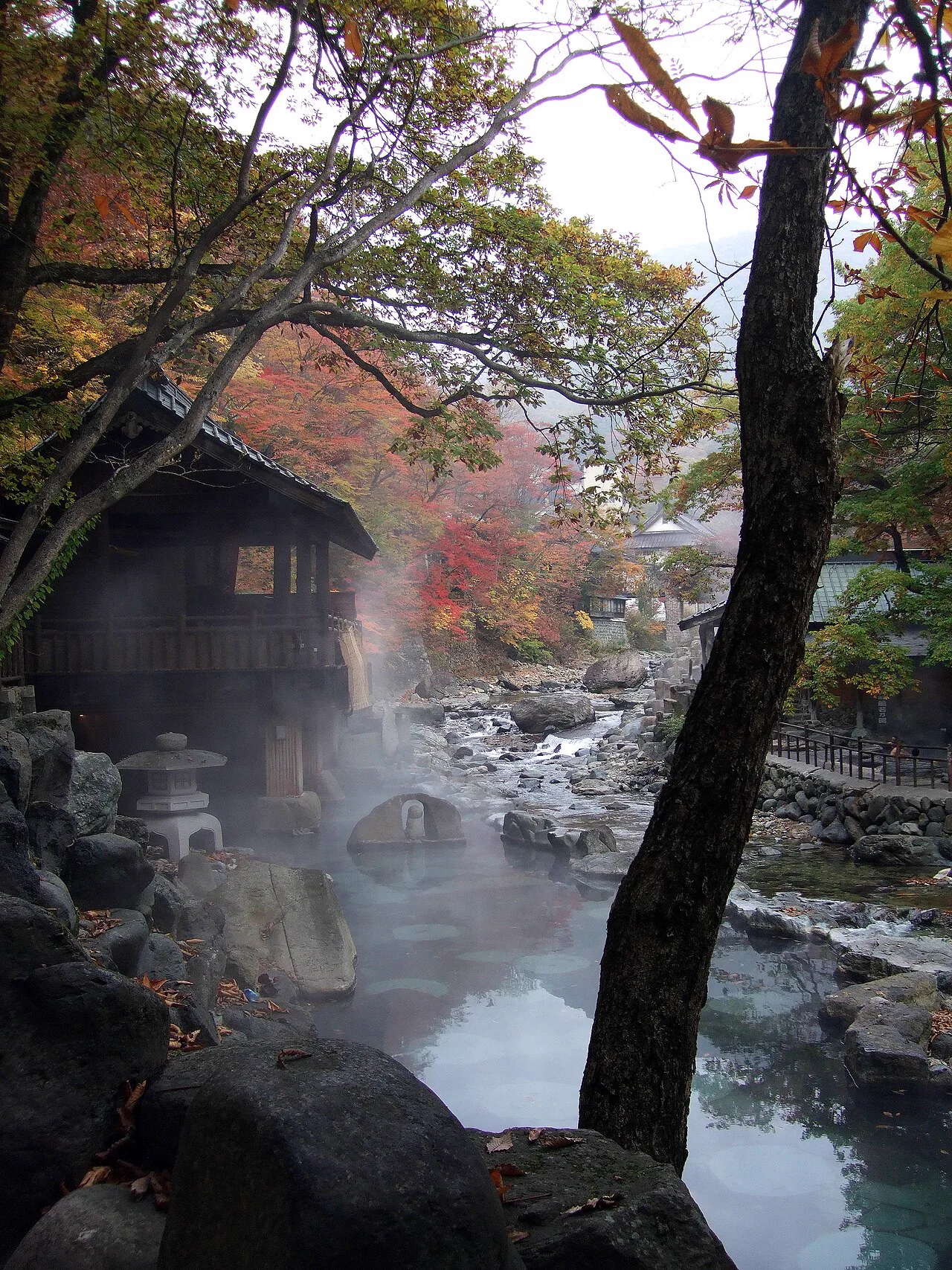
The indoor bath is built from cedar logs. Minerals from the water have built up over time on the wooden surface, giving the tub a thick, stone-like crust. The outdoor bath is made from a large zelkova log tub. Water spills from the indoor bath into the outdoor one, which the operator describes as a little cooler, with a view into the surrounding valley. These are the two main bathing environments, not a multi-pool spa with sauna facilities.
The official spring output—about 500 litres per minute—is a flow rate, not a temperature. Keeping those measurements separate matters here: the source is distinctive because of its volume and mineral deposits, while the indoor bath temperature is listed separately at about 39°C.
Getting there: possible without a car, awkward to improvise
The inn lists a 60-minute bus journey from Kintetsu Yamato-Kamiichi Station and a 30-minute taxi ride from Roadside Station Sugino-yu Kawakami. It has 12 parking spaces, including a second lot a little farther from the entrance. By car, the operator estimates about 90 minutes from Kōriyama Interchange or 80 minutes from Katsuragi Interchange.
Public transport works only if the local bus and final connection line up with your date. Kawakami Village’s Yamabuki Bus has a limited timetable and does not run on Sundays or public holidays.
The timetable taking effect on 1 October 2026 moves the weekday No. 2 bus from the Inami stop from 4pm to 3:50pm, close to Yamabatoyu’s 4pm last-admission cutoff. That is a return option, not a sensible arrival target. Check both directions before travelling, and arrange a taxi in advance if your bus ends at Sugino-yu rather than at the inn.
The approach is steep and rural. Reviews and the facility’s location both point to steps between the parking area and the bathing rooms, so this is not a good choice for anyone who needs a step-free route unless the inn confirms an accessible arrangement. If the timetable or stairs make the trip too demanding, Nara has easier options; the Nara mountain onsen comparison covers four baths on different regional routes, and the Nara day-use guide includes more accessible city-side choices.
A longer stop works better than a rushed soak
The on-site dining room is listed as open 11am–3pm, leaving a practical window for a meal before or after bathing. The day-use bathing window is short enough that a late arrival can squeeze both the meal and the bath. If food is part of the plan, check service availability when you call and allow time for the drive back; do not count the dining room as a late-day fallback.
Yamabatoyu is worth the detour for drivers who value a strong, undiluted spring and a valley-facing outdoor bath. For a quick city soak, a late-afternoon visit, a sauna, or an unplanned bus excursion, it is the wrong fit. Decide around the opening calendar and return journey first; the ¥900 ticket is the easy part.
Sources
- [Yamabatoyu: day-use admission, bath details and tattoo policy](https://yamabatoyu.co.jp/onsen) - [Yamabatoyu: 2026 operating schedule](https://yamabatoyu.co.jp/schedule) - [Yamabatoyu: access, drive times and parking](https://yamabatoyu.co.jp/access) - [Kawakami Village: Yamabuki Bus timetable revised 1 October 2026](https://www.vill.kawakami.nara.jp/life/docs/2026090800014/) - [Nara Prefecture Tourism: Yamabatoyu hours, seasonal closures and access](https://yamatoji.nara-kankou.or.jp/08onsen/01onsen/04south_area/yamabatoyu/access/) - [Jalan: Yamabatoyu listing and visitor reviews](https://www.jalan.net/kankou/spt_29452cd2110076932/)Checked: 27 September 2026. Tags: Irinoha Onsen, Yamabatoyu, Nara, Kawakami Village, day-use onsen, mountain hot spring, sodium bicarbonate spring, free-flowing onsen, outdoor bath, Ōsako Dam, Mount Ōdaigahara, rural travel, Nara onsen, bus access, Japan hot springs