Kusatsu’s Six Hot-Spring Sources: Where to See Them and Where to Bathe
Find Kusatsu’s Yubatake, Sainokawara, Jizo, Nikawa, Shirahata and Bandai springs; source names do not always match the bath they feed.
Kusatsu’s source names do not always match the baths they feed. Some springs supply public baths; others are mainly visible at the source. Hotels may draw water from springs several kilometres away. The table below shows where to see each source and which baths use its water.
The six sources at a glance
| Source | Source temperature / pH | What it looks like | Where to encounter it |
|---|---|---|---|
| Yubatake | 55.7°C / 2.08 | Clear, with a faint sulphurous smell | Chiyonoyu; one of Gozanoyu’s two spring rooms, which alternate between men and women by day |
| Sainokawara | 49.3°C / 2.08 | Clear water emerging at several points in the park | Sainokawara Park’s streams and spring vents. The nearby Sainokawara Rotenburo uses Bandai water instead. |
| Jizo | 53.0°C / 2.05 | Slightly cloudy, with sulphur smell | Jizo-no-yu and the small spring area in Ura-Kusatsu |
| Nikawa | 51.6°C / 2.10 | Clear, with a faint sulphurous smell | Ohtakinoyu and Nikawa-no-yu |
| Shirahata | 55.5°C / 2.06 | The only one of the six that is milky white; visible mineral deposits | Shirahata-no-yu and selected inns, including Naraya and Hotel Ichii |
| Bandai | 95.4°C / 1.70 | Clear and odourless at the source | Sainokawara Rotenburo, Gozanoyu’s alternating spring room and many hotels |
These figures describe water at the source, not the temperature in a bath. Bandai emerges close to boiling and is cooled before it reaches a tub. A facility’s supply, cooling method and bath design all affect how the water feels, so enter gradually and follow the posted guidance.
A useful first comparison: Nikawa, Shirahata and Jizo
Naraya or Ohtakinoyu: Shirahata or Nikawa?
Naraya is a ryokan whose baths draw Shirahata spring; Ohtakinoyu is a day-use bathhouse supplied by Nikawa. Both are acidic, sulfur-bearing sources, but their recorded source temperatures and pH are not identical. Those are measurements at the spring, not fixed temperatures or pH readings for every bathing pool.
| Source detail | Naraya | Ohtakinoyu |
|---|---|---|
| Spring | Shirahata | Nikawa |
| Published source type | Acidic, sulfur-bearing aluminium-sulfate/chloride spring (hydrogen-sulfide type) | Acidic, sulfur-bearing aluminium-sulfate/chloride spring (hydrogen-sulfide type) |
| Source temperature | 55.5°C in the spring distributor’s profile; Naraya describes fresh water at about 55–56°C | 51.6°C in the spring distributor’s profile |
| Source pH | 2.06 in the spring distributor’s profile | 2.10 in the spring distributor’s profile |
| At the source | Milky white, with a sulfur smell | Clear, with a faint hydrogen-sulfide smell |
| Water handling and bathing options | Naraya | Ohtakinoyu |
|---|---|---|
| Water handling | Naraya’s yumori cool the spring along a gravity-fed route, hold it overnight, then adjust the flow into each bath. The inn describes its public baths as 24-hour kakenagashi. | The facility describes its baths as kakenagashi. In the Awaseyu, source water passes through a sequence of basins and cools naturally, without dilution. |
| Bath types | Two communal bathing areas, with indoor baths; Hana-no-yu also has an open-air bath. Three private outdoor baths are available separately. | Large indoor bath, waterfall-style outdoor bath, Awaseyu sequence, cold bath and sauna; a private bath is also available. |
For the detailed stay and private-bath rules at Naraya, check which room and booking arrangement suits you. At Ohtakinoyu, the Awaseyu sequence is the distinctive feature: start at the cooler end and move on only if the next basin feels comfortable. On the second and fourth Saturday of each month, pipe cleaning can make Nikawa water turn cloudy; the operator recommends visiting in the morning for the strongest effect.
Shirahata-no-yu is a free community bath beside Yubatake, open 8:00 am–11:00 pm. Its white water and mineral deposits are easy to distinguish from the clear Nikawa water. There are no locked valuables lockers, and cleaning can temporarily close the bath, especially in the morning; leave valuables at your accommodation and check the entrance before settling on a time.
Jizo-no-yu sits about three minutes on foot from Yubatake, in the Ura-Kusatsu area. The small spring basin, footbath and hand-washing spot are clustered nearby, so the walk still has a purpose if the bath is unavailable. The public bath is managed as a local community facility; follow its posted instructions and do not treat it like a staffed tourist bath. For a reserved private bath, Traditional-yu Jizo currently offers one-hour slots for ¥3,500 per group of up to ten, with reservations required; it closes Wednesdays.
For a half-day, Ohtakinoyu followed by Shirahata-no-yu gives you two clearly different springs without much backtracking. If you have an overnight stay, leave Jizo for the next morning and add Ura-Kusatsu’s spring area to the walk.
Sainokawara Park is not the Sainokawara bath
The park has dozens of spring vents and warm streams. Sainokawara Rotenburo, at the far end, is a separate bath supplied with Bandai water.
| Sainokawara Rotenburo detail | Current listing |
|---|---|
| Adult admission | ¥800 |
| Hours, April–November | 7 a.m.–8 p.m. |
| Hours, December–March | 9 a.m.–8 p.m. |
| Last entry | 30 minutes before closing |
| Second Wednesday of each month | Cleaning closure at 5 p.m.; last entry 4:30 p.m. |
Check the current notice before visiting.
Gozanoyu is another way to try Bandai, but its two rooms switch between men and women daily. One room uses Yubatake water and the other Bandai, so check the day’s rotation if one particular source matters to you. Both Gozanoyu and Sainokawara Rotenburo can provide a Bandai bath; visiting both makes more sense for their different settings than for source variety. The three public baths compared covers facilities and admission in more detail.
Wata-no-yu is a separate source
Wata-no-yu is not part of the usual six-source list. It is a limited-distribution spring used by certain inns rather than a public source visitors can freely enter. Its water is slightly cloudy, with a sulphurous smell; the spring company lists it at 51.1°C and pH 2.11. At Tokinoniwa, the large Tokino-yu bath uses Wata-no-yu, while the Kono-yu bathing area uses Yukawa-no-yu. Check the specific property’s current bathing information before choosing a stay around this spring.
If you are deciding where to stay as well as what to bathe in, the Kusatsu Onsen guide explains how the central hot-spring district and Ura-Kusatsu fit into a visit.
Sources
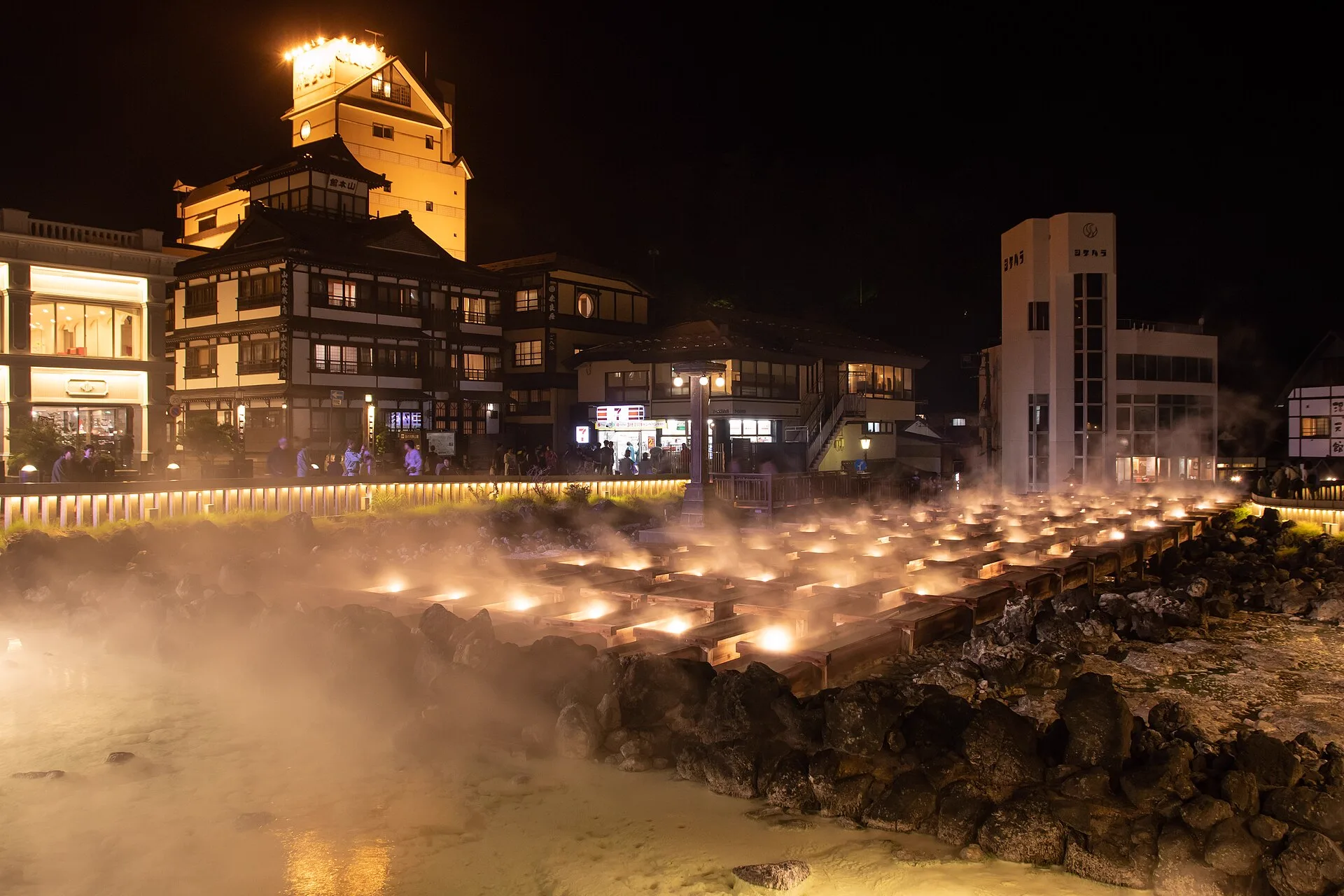
- [Kusatsu Shirane Spring Distribution Co.: the six main sources and Wata-no-yu](https://www.kusatsu-onsenhaitou.com/watanoyu/) - [Kusatsu Onsen Tourism Association: Ohtakinoyu](https://www.kusatsu-onsen.ne.jp/kankou/1092.php) - [Ohtakinoyu: cloudy-water days and Awaseyu](https://onsen-kusatsu.com/ohtakinoyu/cloudy-white/) - [Kusatsu Naraya: Shirahata spring, water handling and baths](https://www.kusatsu-naraya.co.jp/onsen/) - [Ohtakinoyu: spring quality, kakenagashi and bathing facilities](https://onsen-kusatsu.com/ohtakinoyu/hot-spring/) - [Kusatsu Shirane Spring Distribution Company: source type, temperature and pH](https://www.kusatsu-onsenhaitou.com/watanoyu/) - [Kusatsu Onsen Tourism Association: Shirahata-no-yu](https://www.kusatsu-onsen.ne.jp/kankou/1097.php) - [Kusatsu Onsen Tourism Association: Gozanoyu](https://www.kusatsu-onsen.ne.jp/kankou/1090.php) - [Sainokawara Rotenburo: admission, hours and facilities](https://onsen-kusatsu.com/sainokawara/guide/) - [Sainokawara Rotenburo: monthly cleaning schedule](https://www.kusatsu-onsen.ne.jp/information/1942.php) - [Ura-Kusatsu Jizo: Jizo-no-yu and Traditional-yu Jizo](https://www.kusatsu-onsen.ne.jp/ura-kusatsu_jizo/) - [Hotel Ichii: its Shirahata and Bandai baths](https://www.hotel-ichii.co.jp/spa/) - [Naraya: Shirahata spring and private baths](https://kusatsu-naraya.co.jp/onsen/index.html) - [Tokinoniwa: its two bathing areas and spring sources](https://dormy-hotels.com/resort/hotels/tokinoniwa/hotspring/) - Image credit: Σ64, [Kusatsu Yubatake at night](https://commons.wikimedia.org/wiki/File:Kusatsu_Yubatake,_Gunma_01.jpg), CC BY 4.0; resized and converted to WebP.Checked: September 30, 2026
Tags: Kusatsu Onsen, hot-spring sources, Yubatake, Sainokawara, Jizo-no-yu, Nikawa, Shirahata, Bandai, Wata-no-yu, Kusatsu public baths, Kusatsu bathing map, Gunma onsen, Japan hot springs, onsen itinerary, Kusatsu travel guide