Booking a Ryokan Alone: Check the Room, Dinner, Baths and Last Transfer
Before booking a ryokan alone, confirm the exact single room, dinner cutoff, bath access, stairs, tattoo rules and last transfer for your dates.
“Solo stays available” only tells you that a ryokan accepts one guest in some room types. It does not mean every room is sold to one person, or that a solo room has a window, private bath or the same view as the hotel’s photos.
At Kusatsu’s Naraya, for example, the two rooms sold as singles—Utsugi and Waremokou—have no windows. The inn also has unavoidable stairs and tattoo rules for its public baths. If any of those are firm requirements, choose another room or property before comparing meals and reputation.
Start with the exact room offered for one adult
Naraya confirms that one person can stay in its Western-style single rooms, Utsugi and Waremokou. Its room page says that neither has a window because of the building’s structure. That can be a workable trade-off if you plan to spend the day around Kusatsu and mainly need a place to sleep; it is a poor fit if you expect to read or relax in a bright room.
Do not assume a single room includes a natural hot-spring bath. Naraya lists Iwakagami, a separate maisonette in its Izumiyutei collection, with a semi-open-air bath fed by the source. That room’s feature does not apply to Utsugi, Waremokou or other room types. Search results often collapse different room names under one property listing, so check the full Japanese room name and the bath description before paying.
For any ryokan, search with the actual date, one adult and one room. Compare the bookable room’s total, meals and cancellation deadline—not a per-person rate based on two guests or an undated “from” price. Keep the exact room name and plan in your notes in case you need to change the reservation; Naraya directs guests to make changes through the site or travel agent they booked with.
Decide whether a fixed dinner time suits your evening
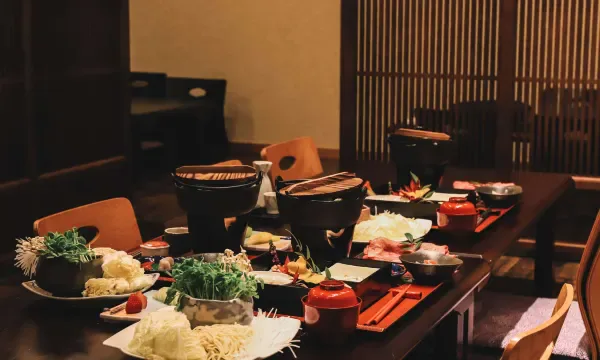
Naraya’s check-in runs from 3 p.m. to 7:30 p.m.; dinner finishes at 9 p.m. Contact the inn if you expect to arrive after 5 p.m. Dinner is served in a dining room, not in guest rooms. Food-allergy or ingredient requests should reach the inn at least a week before the stay. A note added to a late booking is not confirmation that the kitchen can accommodate it.
That schedule suits a traveller who wants to spend the evening at the inn and avoid finding a restaurant after bathing. If you plan a late day trip, want to stay out past dinner or prefer to decide when to eat, a room-only plan may fit better. Check what is actually on sale for your date rather than assuming every property offers both options.
Separate public baths, private-use baths and in-room baths
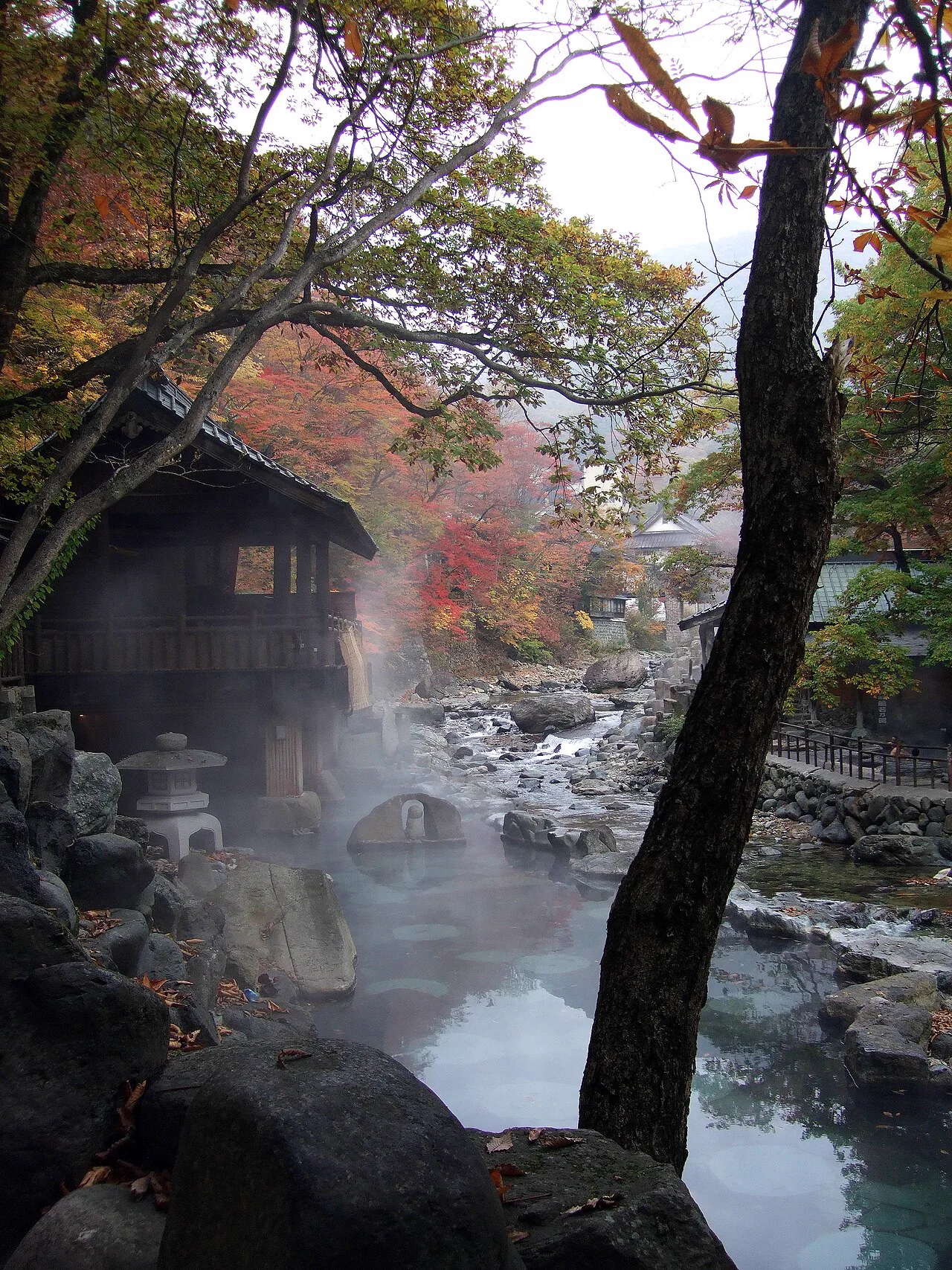
These are three different permissions. Naraya’s two public bathing areas use the Shirahata source and swap between men’s and women’s hours overnight. Small tattoos may be allowed if fully covered with a sticker; other tattooed guests cannot use the public baths. The inn says a paid private bath is an alternative.
There are three private open-air baths, called Hi, Fu and Mi. Each costs ¥3,300 for 45 minutes. Overnight guests book at check-in; advance reservations are not accepted, so the inn cannot guarantee your preferred time before arrival. If a private session is the only way you can bathe, include its fee and the possibility of an unavailable slot in your decision.
The guest-room bath is a separate matter again. Naraya identifies Iwakagami as the room with a source-fed semi-open-air bath. Do not book Utsugi or Waremokou on the assumption that “the hotel has a private onsen” means that feature comes with a single room.
Naraya’s spring information is also useful when comparing other stays. It says fresh water reaches the property at about 55–56°C, is held overnight to cool to about 46–47°C, then flows into the baths at a managed 41–42°C. A source temperature is not the same as the temperature you will bathe in. See our guide to reading onsen water temperatures and understanding spring classifications.
Check the walk inside the inn, not just the map outside
Naraya is about a five-minute walk from the Kusatsu Onsen Bus Terminal, and arriving guests can call for pickup. The route inside is not step-free: the FAQ lists 11 steps at the entrance and 12 on the way to the public-bath floor, with more steps inside the bathing area.
The wooden wing has no lift. Wheelchairs and wheeled mobility aids are not permitted inside, though canes are allowed. Ask the property about your room and route if stairs or walking aids are a concern.
Drivers have a temporary parking arrangement running from August 25, 2026, through March 31, 2027. The inn directs guests to the temporary lot, about a ten-minute walk away, and asks them to call for a ride from the lot. Spaces are limited, and the exact directions matter; check Naraya’s current access notice rather than driving to the entrance by habit.
A quick booking check before you commit
For Naraya, get these details confirmed against your own stay before paying:
- Can Utsugi or Waremokou be booked for one adult on your dates?
- Is the named room windowless, and does its bathroom use hot-spring water?
- What time is dinner, and has the inn accepted any allergy request?
- Are you comfortable requesting a paid 45-minute bath only after arrival?
- Can you manage the stairs, and do the temporary parking instructions apply to your travel date?
For more context, see our Kusatsu Onsen guide, private-onsen ryokan guide and Kusatsu tattoo-bath guide.