Awara Onsen Spring Records at Grandia Hosen, Haiya and Matsuya Sensen
Compare Awara well records at three inns, including dates and room-level limits.
Awara's hot-spring water comes from wells managed by individual facilities. Three inns publish different levels of detail: Grandia Hosen provides analyses for three numbered wells and a dated bath-use chart, Haiya identifies an on-site spring without a well-by-well map, and Matsuya Sensen gives data for a blend used in its public baths.
The distinction matters: source measurements describe water at a well, while a bath may be heated, diluted, filtered or circulated. A published source record does not establish what feeds every tub today.
| Inn | Published record | What it can tell you |
|---|---|---|
| Grandia Hosen | Wells No. 29, 39 and 51; source temperatures 27.2°C, 26.3°C and 31.0°C; pH 8.8, 9.0 and 8.6. All are classified as alkaline simple springs. | A 2017 chart maps those wells to selected baths, footbaths and room baths, and lists water treatment. It does not confirm current assignments for newer room categories. |
| Haiya | On-site sodium-chloride spring, described as weakly saline; the bathing page gives a bath temperature of about 40°C. | No well number, source temperature, pH or bath-by-bath supply map is listed. The 40°C figure describes bathing water, not the source. |
| Matsuya Sensen | Public bath blend from wells No. 14, 43 and 64; source temperature 29.3°C, pH 7.9; sodium-calcium chloride spring. The bath system is circulated. | The inn identifies the public-bath blend, but does not assign a separate well to each tub or say every guest-room bath uses that blend. |
Grandia Hosen publishes the most detailed map
Its well analyses give flow rates of 15.3 litres per minute for No. 29, 77 for No. 39 and 69.1 for No. 51. The reports record a faint hydrogen-sulfide odor at wells No. 29 and 51, and no odor at No. 39. These observations were made at the sources; they do not predict what a guest will notice in a bath.
The inn's bath-use table, updated July 14, 2017, connects No. 29 with the footbath and selected open-air guest-room tubs; No. 39 with the Kotobukitei cypress bath and selected rooms; and No. 51 with Tenjo Spa and two listed room baths. It also records dilution, heating, circulation, filtration and disinfection. The room page now lists categories beyond the old chart, so ask which source currently supplies the specific room you are considering. The Awara ryokan comparison helps weigh that question against bath style and access.
Haiya names its spring, not every connection
Haiya describes its water as an on-site natural sodium-chloride spring with a weakly saline character. Its bathing page mentions water around 40°C and shows two public-bath areas with indoor and outdoor tubs, plus a reclining bath and garden sauna. It does not publish a well number or identify a source for each tub.
Guests choosing a room with a private bath may want to ask whether that room uses natural spring water. The Awara family stay guide covers private-bath and room-layout questions; the car-free Awara itinerary covers transfers from both stations.
Matsuya Sensen identifies a public-bath blend
The three-well blend comes from wells No. 14, 43 and 64. Matsuya Sensen classifies it as a low-temperature, weakly alkaline sodium-calcium chloride spring, lists its source temperature at 29.3°C and pH at 7.9, and states that the baths circulate water. Its public baths include different tubs and bathing styles, but the published analysis does not say that each tub draws from a separate well.
Overnight bath hours are 2 p.m.–1 a.m. and 5–10 a.m.; sauna hours are 3–10 p.m. and 6–9 a.m. Men’s and women’s areas offer different selections. The Matsuya Sensen stay guide sets out those practical differences, while the Mimatsu stay guide and Seifuso stay guide cover two other bathing setups in town.
What to ask before choosing a room
If source identity is a deciding factor, ask the inn which well supplies the exact room or bath, whether the water is heated or diluted, and whether it is circulated. If the priority is trying several bathing styles, hours, access and room location may be more useful than a difference in pH or source temperature. The Saintpia-versus-ryokan comparison covers a day-use alternative; the Awara one-night itinerary and budget-stay guide add trip and cost context.
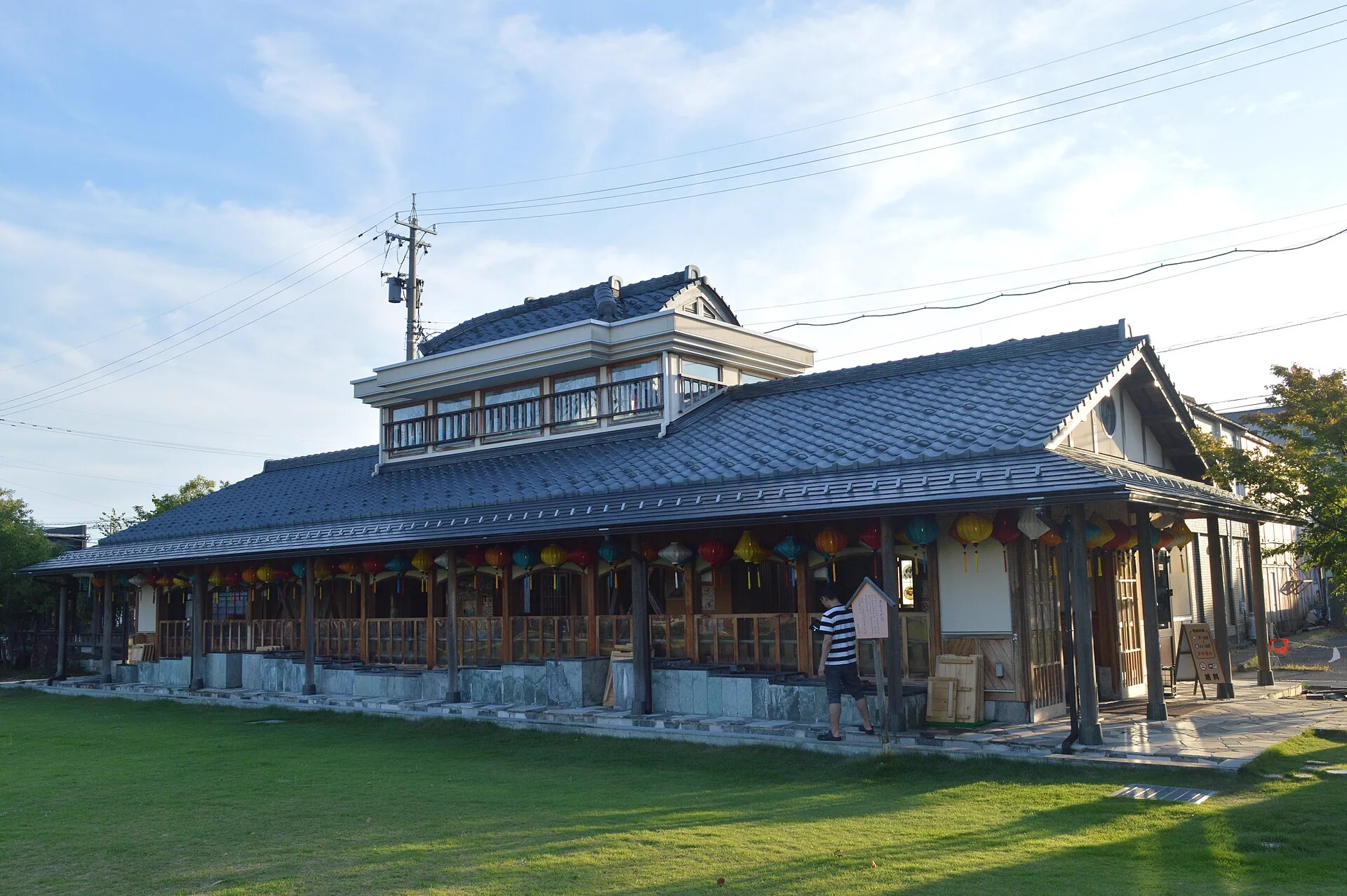
Photo: Asturio Cantabrio, Ashiyu public footbath.jpg), CC BY-SA 4.0. This is a town footbath, not a bath at any of the inns above.
Sources
Checked: October 24, 2026. Grandia Hosen's source analyses date to 2014–2015; its well-to-bath chart is dated July 14, 2017. - [Awara Onsen Ryokan Association: individual inns manage their wells](https://www.awara-onsen.org/about/) - [Grandia Hosen: source analyses and bath-use chart](https://www.g-housen.co.jp/hot-spring/effect/) - [Grandia Hosen: current room categories](https://www.g-housen.co.jp/room/) - [Grandia Hosen: station shuttle](https://www.g-housen.co.jp/access/) - [Haiya: spring type and baths](https://www.haiya.jp/spa/) - [Haiya: station access](https://www.haiya.jp/access/) - [Matsuya Sensen: spring data, bath and sauna hours](https://matuyasensen.co.jp/spa/) - [Matsuya Sensen: station shuttle](https://matuyasensen.co.jp/access/)Awara Onsen, spring source, Grandia Hosen, Haiya, Matsuya Sensen, Fukui