Sumire no Yu or Gokurakuyu Ibaraki? Two Early Baths in Northern Osaka
Compare Sumire no Yu and Gokurakuyu Ibaraki by early opening, admission, spring baths, sauna, towels, transport and family rules.
Both bathhouses open at 6 a.m. on weekends and holidays, with natural hot-spring water and saunas. Sumire no Yu has a designated free-flowing source bath and a separate clothing-on heated-room spa. Gokurakuyu Ibaraki is closer to JR Sojiji Station; its ¥600 Public Bath ticket covers indoor bathing but excludes the outdoor baths and both saunas.
| Sumire no Yu | Gokurakuyu Ibaraki, Royal ticket | |
|---|---|---|
| Adult weekday admission | ¥900 | ¥900 |
| Adult weekend/holiday admission | ¥1,000 | ¥980 |
| Weekend opening | 6 a.m. | 6 a.m. |
| Weekday opening | 9 a.m. | 8 a.m. |
| Closing / last admission | 2 a.m. / 1 a.m. | 2 a.m. / 1:30 a.m. |
| Natural spring highlight | Designated free-flowing source bath | Natural water in selected baths; carbonated bath uses the spring as its base |
| Extra heated-room area | Jjimjilbang, separate charge | No equivalent clothing-on spa area |
| Walk from station | Toyokawa, about 5 minutes | JR Sojiji, about 6 minutes |
Gokurakuyu's ¥600 Public Bath ticket excludes the outdoor area, dry sauna and steam sauna, and does not allow re-entry. For those facilities, the Royal prices in the table are the relevant comparison.
At Sumire, the spring bath is the reason to go
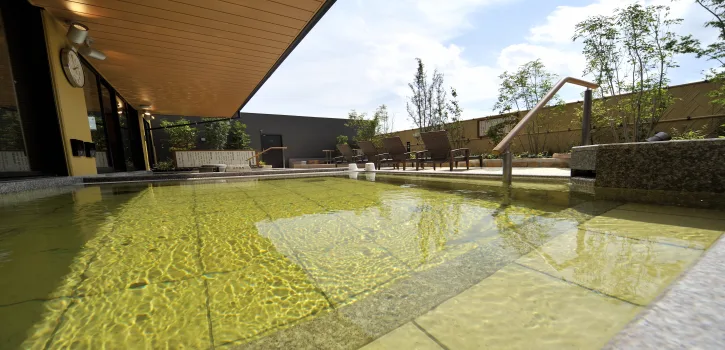
Sumire has 13 bath types. Its “Source Spring Bath” draws water from around 1,000 metres underground and is free-flowing; other outdoor baths use natural spring water too. The carbonated bath uses deep groundwater with added carbon dioxide.
Adult admission is ¥900 on weekdays and ¥1,000 on weekends and holidays. A face and bath towel set costs ¥250 extra. Two saunas are included; the clothing-on heated rooms and lounge require a separate jjimjilbang ticket and suit a longer stay.
Sumire opens at 9 a.m. on weekdays and 6 a.m. on weekends and public holidays, closing at 2 a.m. Last admission is 1 a.m. Toyokawa Station on the Osaka Monorail Saito Line is about five minutes away on foot. Its former shuttle bus has ended.
The clothing-on jjimjilbang is separate from the bath ticket. Adult prices are:
| Visit | Weekdays | Weekends and holidays |
|---|---|---|
| Bath | ¥900 | ¥1,000 |
| Jjimjilbang add-on | ¥800 | ¥900 |
| Bath plus jjimjilbang | ¥1,700 | ¥1,900 |
The shared clothing-on area gives groups time together outside the gender-separated baths; for a short soak, the add-on may not be worthwhile.
Gokurakuyu is the easier JR stop
Gokurakuyu's Royal ticket is ¥900 on weekdays and ¥980 on weekends and holidays, covering the outdoor baths, an auto-loyly sauna and a steam sauna. Its sodium-calcium chloride spring water is used in selected baths, including as the base for its carbonated bath. The other tubs have separate water treatments.
JR Sojiji Station's north exit is around six minutes away. On weekdays, Gokurakuyu opens at 8 a.m., an hour before Sumire; on weekends, both open at 6 a.m. Gokurakuyu's last admission is 1:30 a.m., half an hour later than Sumire, though arriving then leaves little time to bathe.
The ¥600 Public Bath ticket works if all you want is a basic indoor soak. It excludes the outdoor area and saunas, is cash-only and does not include re-entry. Decide based on the facilities you will use, not the headline price.
The two full-ticket saunas are different formats: Gokurakuyu has an auto-loyly dry sauna and a steam sauna, while Sumire lists a far-infrared sauna and a medicinal-herb steam sauna. Sumire’s 13 bath types also include a designated source bath that the operator describes as free-flowing. Its carbonated bath uses deep groundwater with added carbon dioxide, so “natural spring” should not be applied to every pool simply because it is on the same floor.
Which one fits your route?
Sumire fits a day around Saito or Expo ’70 Commemorative Park, especially if the free-flowing bath or clothing-on heated rooms are priorities. Gokurakuyu is the simpler trip from the JR Kyoto Line, including stays around Osaka, Takatsuki or Ibaraki.
For a quick indoor soak without sauna, Gokurakuyu's ¥600 ticket keeps the cost down. The full weekend tickets differ by only ¥20, so the bathhouse nearer your day's route is usually the practical choice.
Before you go
Both places open at 6 a.m. on weekends and holidays and stay open until 2 a.m. Check for maintenance notices before travelling.
Both bathhouses prohibit tattoos and tattoo cover stickers.
Gokurakuyu’s basic ticket excludes the outdoor area, both saunas and re-entry. Sumire sets child prices by age, and children under two cannot use its jjimjilbang. Check the operators’ current family rules if you plan to use the clothing-on area.
| Gokurakuyu child ticket | Price |
|---|---|
| Royal, ages 6–11 | ¥450 |
| Public Bath, ages 6–11 | ¥200 |
| Age 5 and under | Free |
Gokurakuyu’s basic ticket is ¥600.
Sources
- [Sumire no Yu: admission, hours and visitor information](https://sumireno-yu.com/user.html) - [Sumire no Yu: baths and jjimjilbang](https://sumireno-yu.com/onsen.html) - [Sumire no Yu: access](https://sumireno-yu.com/access.html) - [Gokurakuyu Ibaraki: admission, access and hours](https://www.gokurakuyu.ne.jp/tempo/ibaraki/) - [Gokurakuyu Ibaraki: baths and sauna](https://www.gokurakuyu.ne.jp/tempo/ibaraki/ofuro/index.html) - [Gokurakuyu Ibaraki: visitor rules](https://www.gokurakuyu.ne.jp/tempo/ibaraki/beginner/) - [Onsen spring types and water-flow terms](/guides/onsen-spring-quality/)Checked: 27 September 2026. Hours and prices can change; confirm before travelling.