Mimikawa or Dontaro no Yu? Choosing a Day-Use Onsen in Misato, Miyazaki
Both Misato baths charge ¥520 and use sodium bicarbonate springs; choose Mimikawa by the lake or Dontaro no Yu near Nango’s heritage sites.
Checked: September 27, 2026
Misato is spread across mountain districts, so these two baths are not quick alternatives a few minutes apart. Mimikawa no Yu sits beside Ouchibaru Dam Lake in Saigo. Dontaro no Yu is in Kado, Nango, closer to Mikado Shrine and the area’s Baekje-linked heritage sites. Pick the bath that follows your day’s route, rather than driving across town just to compare two pH readings.
The short version
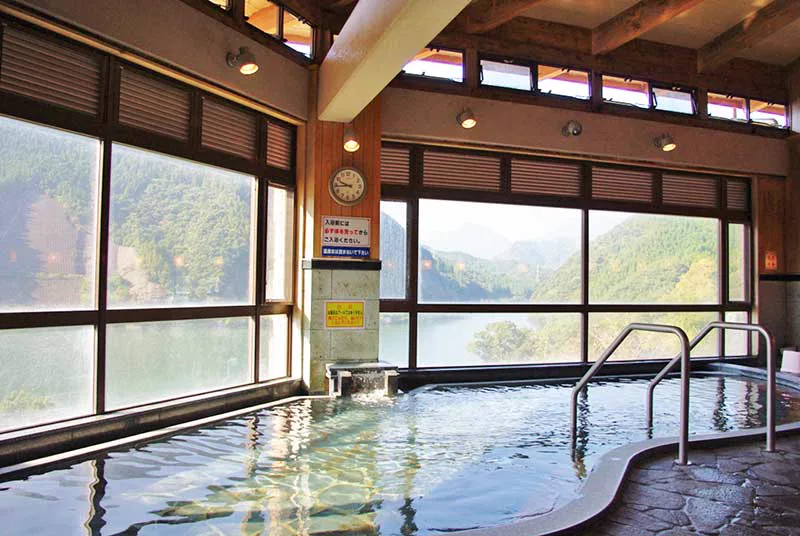
Choose Mimikawa if you want an open-air bath with a lake-and-river-valley setting, several types of tubs, sauna and the option to make a longer stop at Misato Lakeland. The grounds also have cottages, a restaurant, play equipment and seasonal recreation.
Choose Dontaro no Yu if you are exploring Nango, want a private bathing room, or care about having spring analysis figures published in detail. The bath is near the local cultural sites and has a direct Miyazaki Kotsu bus from Hyuga City Station, though the ride takes about 70 minutes and the timetable limits spontaneity.
Both charge ¥520 for adults, ¥320 for junior-high students and ¥210 for children aged four through elementary school. Mimikawa’s regular closing days are Tuesday and Wednesday; Dontaro’s is Thursday, shifting to Friday when Thursday is a public holiday. Check each operator’s calendar before travelling, since holiday schedules and maintenance can override the usual pattern.
What the same spring label does—and does not—tell you
Both facilities list sodium bicarbonate springs. Published source figures differ: Mimikawa lists 41.3°C, pH 8.3 and 167.1 litres per minute; Dontaro lists 37.1°C, pH 8.7 and 124.2 litres per minute. These figures describe the springs, not the temperature or water treatment of each bathing tub. A higher pH or flow rate is not a reliable shortcut to deciding which bath will feel better.
Dontaro’s operator presents the facility as a natural flow-through hot spring. Misato Town’s maintenance records also refer to circulation, heating and disinfection equipment, without breaking down treatment by individual tub. Mimikawa’s current pages describe its spring and baths but do not claim that every bath is fully flow-through. Neither facility publishes a complete, tub-by-tub water-treatment specification.
The setting is the bigger difference
Mimikawa is the more flexible stop for a mixed group. Its bathing area has indoor and outdoor pools, electric, bubble and jet baths, plus a sauna. Outside the bath, Misato Lakeland has cottages, walking paths, play facilities and a summer-only pool. The grounds give non-bathers somewhere to spend time, though the pool and other seasonal facilities have their own operating calendars.
Dontaro’s appeal is more focused. There are indoor and outdoor baths, a sauna, a rest hall and restaurant, with a private room bath that must be booked by phone. The operator lists one private-room booking per day, from 1 to 4 p.m., for ¥1,500 per hour. Its published page does not make clear whether that fee includes the ordinary bath admission, so ask when reserving.
Getting there shapes the choice
Without a car, Dontaro has the clearer published route: the operator lists a bus from JR Hyuga City Station toward Mikado, around 70 minutes, stopping at the facility. Check the outbound and return departures for your date; Miyazaki Kotsu has a timetable revision scheduled for October 1, 2026.
Mimikawa is part of the broader Saigo-side Lakeland complex. The local tourism page lists its address and regular hours, while the facility mentions arranging transport for groups using the bath and meal service. That is not the same as a scheduled public shuttle for individual visitors. If you do not have a car, confirm the full route and stop before committing to a visit.
For a road trip, keep the districts separate in your day plan. Mimikawa pairs with the Saigo area and the lake; Dontaro fits a Nango itinerary around the heritage sites. Driving to both in one day can work, but it adds mountain-road time that a simple “same town” map view hides.
Use the calendar before the price comparison
The admission price and usual hours are nearly identical: both baths generally run from 10 a.m. to 8 p.m., with last admission at 7:30. Their regular closing days complement each other, which can make the date itself decisive. Mimikawa usually closes Tuesdays and Wednesdays; Dontaro usually closes Thursdays. Mimikawa also posts monthly calendars, while Dontaro posts weather-related closures and other updates on its home page.
If a facility is the main reason for the drive, check the operator’s latest notice on the day you travel. Mimikawa had a public-bath reopening after a water-quality incident in January 2026 and a separate temporary closure for equipment repairs in June; its current notices are the place to confirm any newer change. A notice about the seasonal pool does not necessarily mean the bath is closed.
For the individual details, see the Mimikawa no Yu guide and the Dontaro no Yu guide.
Sources
- [Mimikawa no Yu: spring figures and opening information](https://www.visit-misato.jp/infopage/onsen-mimitsu/), [baths and prices](https://i-lakeland.jp/spa-eat/), [Misato Lakeland overview and closing days](https://i-lakeland.jp/info/) and [operator notices](https://i-lakeland.jp/news/) - [Dontaro no Yu: spring figures and rates](https://www.town.miyazaki-misato.lg.jp/kiji00350/index.html), [bath and private-room details](https://www.nango-spa.co.jp/spa/index.html), [bus access](https://www.nango-spa.co.jp/access/index.html) and [latest notices](https://www.nango-spa.co.jp/) - [Miyazaki Kotsu: route timetables](https://www.miyakoh.co.jp/rosen/timetable-rosen.html) - Image: [Misato Lakeland official bath gallery](https://i-lakeland.jp/spa-eat/)Tags: Misato onsen, Miyazaki day-use hot springs, Mimikawa no Yu, Dontaro no Yu, Nango Onsen