Nyuto Onsen: Day Trip or Overnight Stay?
Nyuto Onsen day trip or overnight stay? Compare baths, passes and the bus plans.
Nyuto Onsenkyo is a cluster of inns along mountain roads, so a bath visit involves transport planning as well as choosing a spring. Each property sets its own day-use hours, and the public bus to Tazawako Station runs on a timetable that should shape the day. Choose a day trip for a specific bath; stay overnight if you want a slower visit or more than one property.
| Day trip | Overnight | |
|---|---|---|
| Getting to Nyuto | Ugo Kotsu Nyuto Line from Tazawako Station | The same bus, or an inn-arranged pickup for properties such as Tsurunoyu |
| Baths | Pay each inn separately; check its day-use hours | The inn’s guest bathing plus other baths if their hours and shuttle fit |
| Local shuttle | Yumeguri Map: ¥1,000 for rides on the purchase day | Yumeguri-cho: ¥2,500 for member-inn guests, valid for one year |
| Time available | One day, planned around the outward and return buses | Arrival afternoon and the following morning, with the evening at your inn |
| Best suited to | One or two baths, or a base near Tazawako | Several baths, guest-only bathing, dinner and a mountain stay |
The names are easy to mix up, but the two products cover different legs of a visit. The Yumeguri-cho is sold for cash to guests at the seven member inns. It includes one bath visit at each property and unlimited Yumeguri-go rides during its one-year validity. Day visitors can buy the Yumeguri Map for shuttle rides on the purchase date; bath admission remains separate. Neither pass covers the Ugo Kotsu bus between Tazawako Station and the onsen area.
The association lists the adult booklet at ¥2,500 and the children’s version at ¥1,000. Both remain valid for a year, so there is no need to visit all seven baths in one stay. The adult Map costs ¥1,000 for same-day shuttle use. Confirm current terms before paying, especially if travelling with children.
Choose a day trip if you have a clear target
Base yourself around Tazawako and a day visit can be straightforward: take the public bus, use one bath, then return on a departure you have already checked. This works best when a particular inn is the reason for the trip. Adding a second stop means coordinating two separate day-use windows with the local shuttle or walking conditions, not simply strolling to the next bath.
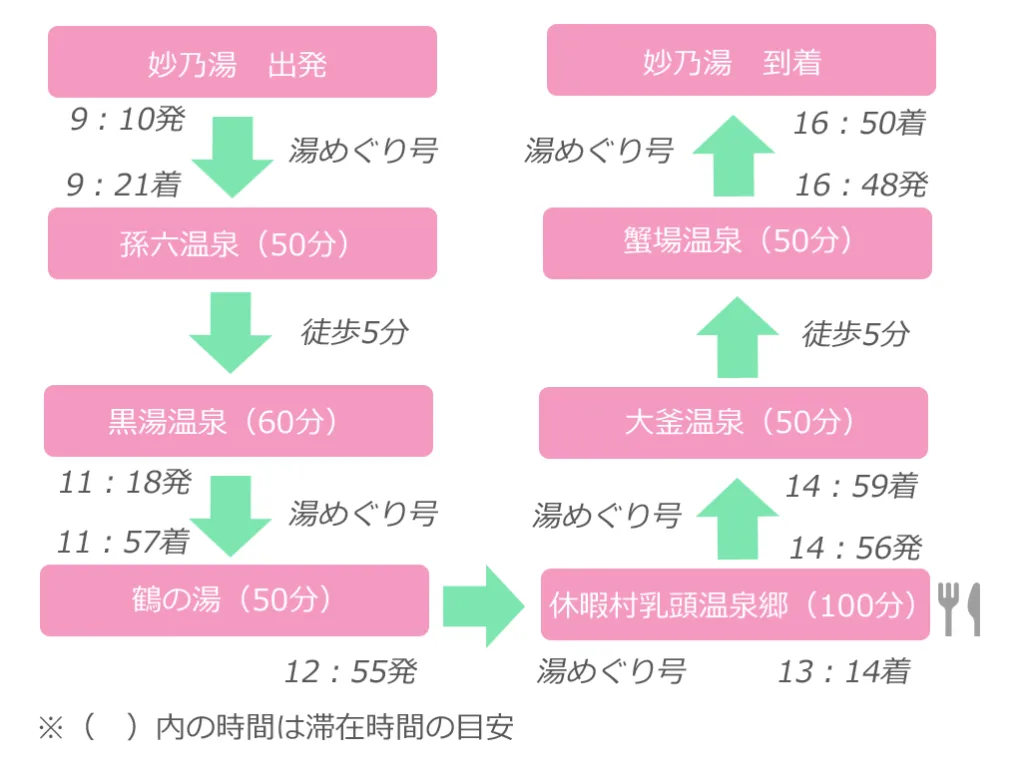
The Map earns its place when the Yumeguri-go helps connect the inns you want to visit. If your chosen bath is directly served by the Nyuto Line, buying a local shuttle pass may add little. In either case, pay admission at the facility and check that the shuttle runs during its day-use hours.
Opening days, last entry and seasonal operation differ by inn. Verify all three for your date; a property appearing on the area map does not mean its baths are open to day visitors every day.
Stay overnight if you want the full circuit at your own pace
Book a member inn if you want access to the Yumeguri-cho and the extra hours around dinner and breakfast. The booklet is most useful when you plan to try another property or return to Nyuto within its validity period; the room itself does not make every bath available at any time. Families should check the child fare and facility rules directly.
With one night, settle into your own inn on arrival and leave another bath for the next morning only if its hours and shuttle line up. That pace leaves time for dinner and the return trip without squeezing several soaks into a short window.
An overnight reservation is the way to experience guest bathing outside day-use hours and to have dinner at the inn. Compare the total room-and-meal price for your dates with the transport and admission costs of a day trip; the pass alone cannot establish which option costs less.
Private bathing, meal plans and access to particular pools are property-specific. Read the plan details and ask the inn about reservations before booking; a stay at one member property does not automatically grant access to every private bath.
There is no advantage in treating the booklet as a seven-stop challenge. Its year-long validity lets you save entries for another trip or for seasonal properties such as Kuroyu and Sunroku when they operate. The association also cautions visitors against excessive bathing; take breaks, drink water and stop if you feel unwell.
The booklet is cash-only. Two adults would pay ¥5,000 for it at the listed rate, before the room, meals and station bus. A day visit avoids lodging but still requires return transport and separate bath admission; add the Map only if its shuttle rides fit your route.
Staying overnight does not override each inn’s closure calendar or temporary restrictions. Check the bath you want before you set out, even if your accommodation sells the booklet.
What the bus changes
Ugo Kotsu’s Nyuto Line links Tazawako Station with stops in the onsen area. Yumeguri-go is a separate local shuttle and does not return passengers to the station. For a day trip, reserve time for both legs on the public bus before choosing how many baths to fit in.
The operator’s timetable revised April 1, 2026 lists the final station departure at 17:20, reaching Nyuto Ganiba at 18:08. Return departures from Ganiba include 16:55, 17:40 and 18:15. These are published times, not a guarantee of an on-time connection; road and weather delays are possible. Check the timetable for your date and leave a buffer before a Shinkansen.
The fare table revised April 1, 2026 lists these one-way adult prices:
| Stop | Fare |
|---|---|
| Taenoyu, Kyukamura or Ganiba | ¥950 |
| Arupa Komakusa | ¥750 |
| Tsurunoyu Onsen Entrance | ¥850 |
Do not use Tsurunoyu Onsen Entrance as a drop-off for the inn: the operator says the property is about a 50-minute walk from that stop. Guests should contact Tsurunoyu and arrange its shuttle from Arupa Komakusa. Day visitors need to confirm whether they can use the pickup service.
An inn may remain open after the next station bus has left. Match the bath’s last entry to the return departure, then add a connection margin for rail. Ugo Kotsu flags holiday-period timetable changes and notes that operating conditions can delay services, so use the dated timetable rather than a remembered schedule.
How to use one night—or two—without turning it into a race
One night gives you an evening at your own inn and a possible morning stop elsewhere. Check the other property’s opening time against the shuttle and station bus; if the connections are awkward, spend the morning at your accommodation instead. The association warns against bathing to excess, so breaks matter more than collecting stops.
For two nights, keeping the same room avoids repacking between remote properties. Use the local shuttle for outings where its timetable works. Moving between inns makes sense when each accommodation is a deliberate part of the trip, not as a workaround for distances between baths.
For a day itinerary, start with one bath and add another only after checking its hours and the connection between stops. Changing, washing and waiting for transport all take a share of the day. A night in Nyuto is the better fit when you want the evening atmosphere, several facilities or flexibility around winter conditions.
Winter narrows the margin
Winter changes both the shuttle pattern and the effort needed for short walks. Check the association’s winter timetable and each inn’s seasonal notice; a summer map may not show the service available on your date. Staying in the area can reduce the pressure to complete everything between station buses, but it does not remove the need to confirm opening status.
The association’s winter sheet directs Sunroku visitors to leave the shuttle at Ookama and continue on foot; it estimates about 15 minutes, with snow affecting the walk. Kuroyu operates seasonally and closes in deep winter. Confirm the current winter sheet and facility notice before planning either stop.
Compare transfer logistics in the Nyuto lodging guide; the station-bus article covers routes and fares.
Room rates, meal schedules, tattoo policies and accessibility differ by inn. Ask the property directly about any requirement that could affect your visit; there is no single rule covering the whole area.
For a stay centered on one property, compare Tsurunoyu and Taenoyu, Tsurunoyu and Kyukamura, Taenoyu and Kyukamura, or Kuroyu and Ganiba. The Ganiba–Ookama guide covers overnight versus day-use access; for another region, compare Nyuto with Naruko or Nyuto with Zao in winter.