Dogo Onsen for the Day: Which Bathhouse Should You Choose?
Compare Dogo Onsen Honkan, Asuka-no-yu and Tsubaki-no-yu by price, baths, private use, accessibility and the three-facility pass.
Dogo’s three public bathhouses are close enough to visit on foot, but they suit different kinds of stop. Honkan is the historic landmark, Asuka-no-yu has a public outdoor bath and bookable private rooms, and Tsubaki-no-yu keeps things simple and costs the least. You do not need to visit all three.
| Bathhouse | Adult admission | Opening hours and limit | Choose it for |
|---|---|---|---|
| Dogo Onsen Honkan, Kami-no-yu downstairs | ¥700 | 6 am–11 pm; tickets stop at 10:30 pm; 60 minutes | The historic wooden building and a straightforward bath |
| Asuka-no-yu, first floor | ¥610 | 6 am–11 pm; last admission 10:30 pm; 90 minutes | A public outdoor bath and a newer building inspired by the Asuka period |
| Tsubaki-no-yu | ¥500 | 6:30 am–11 pm; tickets stop at 10:30 pm; up to 60 minutes | The lowest-cost visit and a no-frills local bath |
These are the basic adult tickets. The three-facility pass costs ¥1,440 for adults and ¥680 for children, and covers one visit to each bathhouse on the day you buy it and the following day. Buying the three adult tickets separately comes to ¥1,810, so the pass saves ¥370 if you use all three. It is not an upgradeable ticket, so there is little point buying it if you only want one bath.
The pass price changed on 1 September 2026. Two annual cleaning closures are also listed: the Honkan closes all day on 1 December 2026; Asuka-no-yu and Tsubaki-no-yu close on 2 December. Check the official notices for any other temporary closure before travelling.
Honkan is about the building as much as the bath
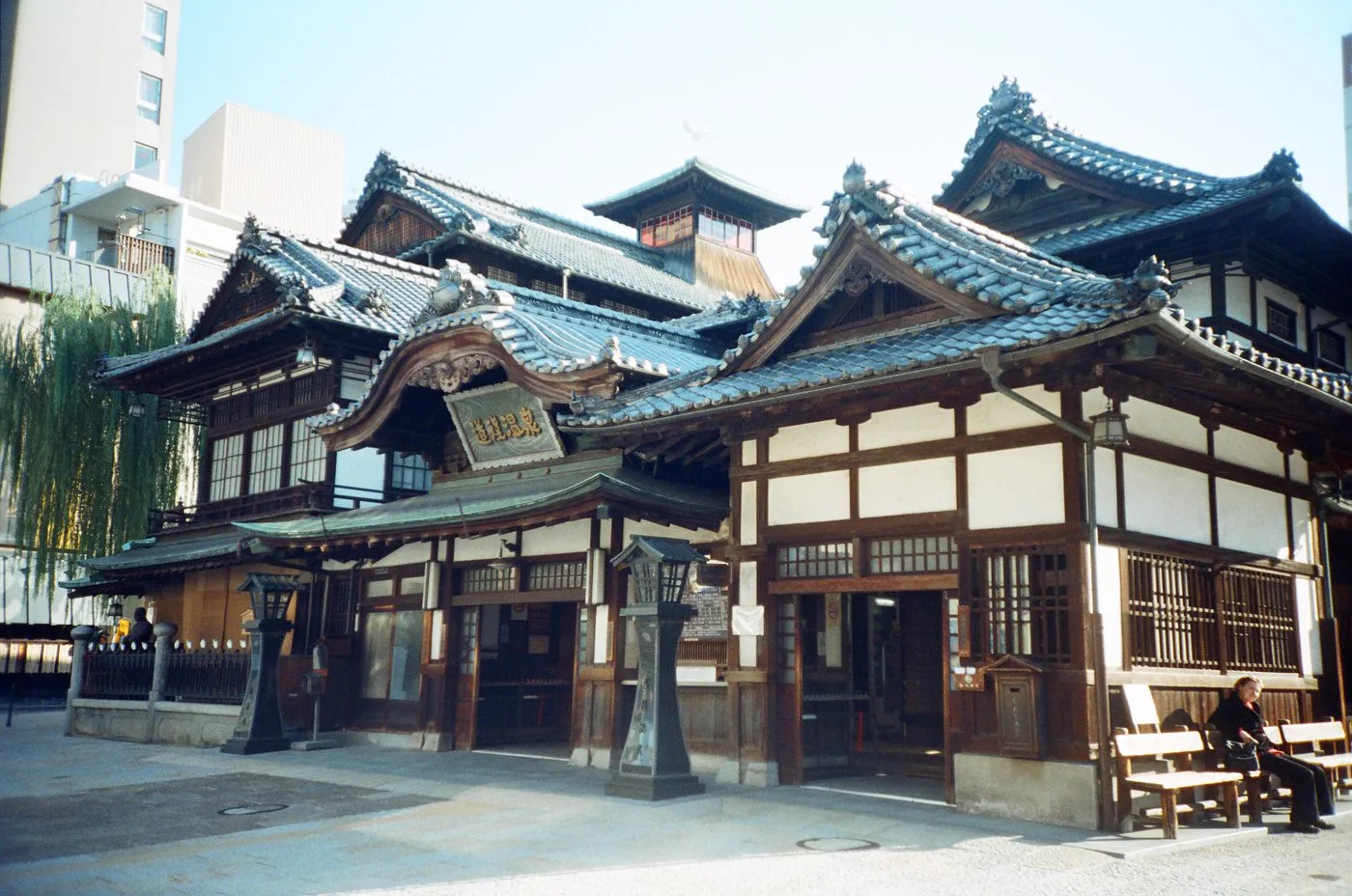
The basic ticket at Dogo Onsen Honkan admits you to Kami-no-yu downstairs. The restored wooden bathhouse is the best fit if its history and architecture are part of why you came to Dogo. There is no public outdoor bath, and the building has numerous steps and level changes; it is not a step-free choice.
Higher-priced Honkan plans add a shared lounge or a private room for resting, along with access to other bathing areas depending on the ticket. “Private room” does not mean private bath. If you want a bath for your own group, Asuka-no-yu is the relevant option.
Asuka-no-yu has the widest range of bathing options
The first-floor ticket includes the shared indoor bath and public outdoor bath. For a bath your party can use alone, the second-floor special rooms are bookable: the charge is ¥2,040 per group plus ¥1,690 per adult, with a separate child charge. Two adults pay ¥5,420 in total. Reservations open 90 days ahead; on the day, ask the facility about any remaining slots. Soap cannot be used in the special room, so washing is done in the first-floor public bathing area.
Asuka-no-yu has a ramp at the entrance and an elevator, with a step-free route through the facility. That can make it easier to plan for someone who cannot manage the Honkan’s stairs, though individual bathing needs still depend on the person and the facility’s layout.
Tsubaki-no-yu is the budget pick
Tsubaki-no-yu is a simple indoor public bath using Dogo’s spring water. It does not have the Honkan’s historic interiors or Asuka-no-yu’s outdoor and private-bath options. Its main advantage is the ¥500 adult ticket. Bring your own shampoo and body wash or buy them there; complimentary washing products are not provided.
The entrance has a ramp and the building has step-free features. If your main aim is an inexpensive soak and you do not need an outdoor bath or a private room, this is the easy choice.
What the water information does—and does not—tell you
All three facilities receive Dogo spring water through the city system. Honkan uses the second distribution station; Asuka-no-yu and Tsubaki-no-yu use the first. The latest analysis gives source temperatures of 48.7°C and 48.1°C, and records 42°C at the point of use.
The city adjusts the temperature by mixing spring water from different sources, without reheating it or adding ordinary water. Bath temperatures can still differ by tub and operating conditions.
“Flow-through” also does not mean “undisinfected.” Matsuyama City’s public-bath information says all three facilities use chlorine disinfection under prefectural hygiene rules. It also lists daily water replacement and cleaning. Those operating details are useful context, but they cannot tell you what the changing room looks like on the day you visit.
| Yubiyori rating | Honkan | Asuka-no-yu | Tsubaki-no-yu |
|---|---|---|---|
| Soaking comfort | 80 | 90 | 75 |
| Bath variety | 75 | 95 | 45 |
| Cleanliness | 80 | 90 | 80 |
| Atmosphere | 100 | 90 | 55 |
| Quiet | 55 | 70 | 70 |
| Access | 100 | 95 | 95 |
| Experience value | 95 | 90 | 100 |
These are comparative editorial ratings, not official facility scores. The Honkan stands out for its historic setting; Asuka-no-yu has the widest choice of bathing arrangements; Tsubaki-no-yu’s strongest point is the low admission price.
Heat, mobility and post-surgery bathing
If you are older, have a heart or lung condition, or are sensitive to heat, do not use the published 42°C point-of-use figure to decide how long you can stay in the water. Start with a short soak, pay attention to how you feel and take breaks. The official analysis advises against bathing during an acute illness or fever and in some serious medical conditions; ask a clinician if you are unsure. Our guide to reading Japanese onsen temperatures explains the difference between source and bath temperatures.
Matsuyama City accepts purpose-made bathing garments for guests with scars from breast cancer treatment, tumours or skin grafts at all three baths. Ordinary underwear and swimwear are not substitutes. For mobility needs, the Honkan has several stairs and level changes, while Asuka-no-yu and Tsubaki-no-yu have step-free features; check the city’s accessibility information for the exact route.
When the three-bath pass earns its place
At ¥1,440, the adult pass saves ¥370 against buying all three basic tickets separately. The saving only matters if you really visit all three. Each stop means another walk, changing room and wash, so on a two- or three-hour visit the Honkan alone may be a better use of time. Overnight guests can split the pass across arrival day and the following morning.
If you are planning around the pass, pair this comparison with the Dogo no-car transport guide or the day trip versus overnight guide. If you only have one bathing slot and are comparing the Honkan with a large bath near JR Matsuyama Station, see Honkan or Kisuke-no-yu?.
A few details that affect the visit
All three are public, day-use bathhouses; none offers overnight accommodation. Their usual hours also have different morning openings: Honkan and Asuka-no-yu start at 6 am, while Tsubaki-no-yu opens at 6:30 am. Annual cleaning closures are scheduled for 1 December 2026 at Honkan and 2 December 2026 at Asuka-no-yu and Tsubaki-no-yu. Check the official notices before travelling, as other temporary closures can also occur.
The bathhouses use Dogo spring water, and Matsuyama City’s current water-quality information lists chlorine disinfection. “Flow-through” should not be read as “not disinfected.” The city’s accessibility page is also worth checking if steps, handrails or changing-room layout matter to someone in your group. Special bathing garments designed for people with surgery scars are accepted; ordinary underwear and swimwear are not substitutes.
If you are deciding whether to stay overnight so you can spread the baths across two mornings, see the Dogo day trip or overnight guide. For the route from the airport, rail stations or ferry port, use the Dogo public-transport guide.
Sources
- [Dogo Onsen Honkan: tickets and hours](https://dogo.jp/onsen/honkan) - [Asuka-no-yu](https://dogo.jp/onsen/asuka) - [Tsubaki-no-yu](https://dogo.jp/onsen/tsubaki) - [Three-facility pass price change, effective 1 September 2026](https://dogo.jp/news/4393.html) - [Dogo Onsen year-end cleaning closures for 2026](https://dogo.jp/news/4416.html) - Matsuyama City: [spring sources and water distribution](https://www.city.matsuyama.ehime.jp/kanko/kankoguide/kankomeisho/dogoonsen/gensen.html), [water analysis](https://www.city.matsuyama.ehime.jp/kanko/kankoguide/kankomeisho/dogoonsen/info/seibun.html) and [accessibility](https://www.city.matsuyama.ehime.jp/kanko/kankoguide/kankomeisho/dogoonsen/bf.html) - [Dogo Onsen FAQ](https://dogo.jp/faq) Checked: 2026-09-27Tags: Dogo Onsen, Dogo Onsen Honkan, Asuka-no-yu, Tsubaki-no-yu, Matsuyama, Ehime, day-use onsen