Honoyu Ujina or Rakurakuen? Comparing Hiroshima’s two day spas
Both Honoyu sites open at 9 a.m. with natural-spring outdoor baths; Ujina suits central Hiroshima, while Rakurakuen adds a Korean-style heated room.
Checked: 2026-09-27
The two Honoyu branches share a name and the same basic distinction between a ¥500 bath-only ticket and a higher-priced full admission. The bath-only ticket does not include the outdoor baths, sauna or cold plunge. If you want to use the natural spring baths, choose full admission and budget for the day’s weekday, weekend or special-period rate.
Where the branches differ is in location and how long you may want to stay. Ujina is on the south side of Hiroshima, within reach of the port and the city’s tram network. Rakurakuen is farther west, making more sense from Hatsukaichi or on a day already taking you toward Miyajima. Rakurakuen also has a Korean-style heated-room zone, charged separately from admission.
At a glance
| Honoyu Ujina | Honoyu Rakurakuen | |
|---|---|---|
| Adult full admission, weekday | ¥1,000 | ¥1,050 |
| Adult full admission, weekends and holidays | ¥1,100 | ¥1,150 |
| Adult bath-only ticket | ¥500 | ¥500 |
| Open | 9 a.m.–11 p.m.; last entry 10 p.m. | 9 a.m.–11 p.m.; last entry 10 p.m. |
| Natural spring | Spring-source and rock baths outdoors are described as free-flowing | The outdoor source and rock baths are described as free-flowing |
| Extra stay option | Restaurant, rest area and relaxation services | Korean-style heated-room zone, restaurant and relaxation services |
Prices above are the standard published rates. Both facilities may set special-period pricing, and the operators can close temporarily for maintenance. Check the branch notice for your date.
Choose Ujina for a city-side bath
Ujina is the more straightforward option if your plans are centered on Hiroshima Station, downtown or the port. Its regular full-admission rate is ¥1,000 on weekdays and ¥1,100 on weekends and holidays. That ticket includes the outdoor baths, sauna and cold plunge; the ¥500 bath-only ticket excludes those areas and cannot be used for re-entry.
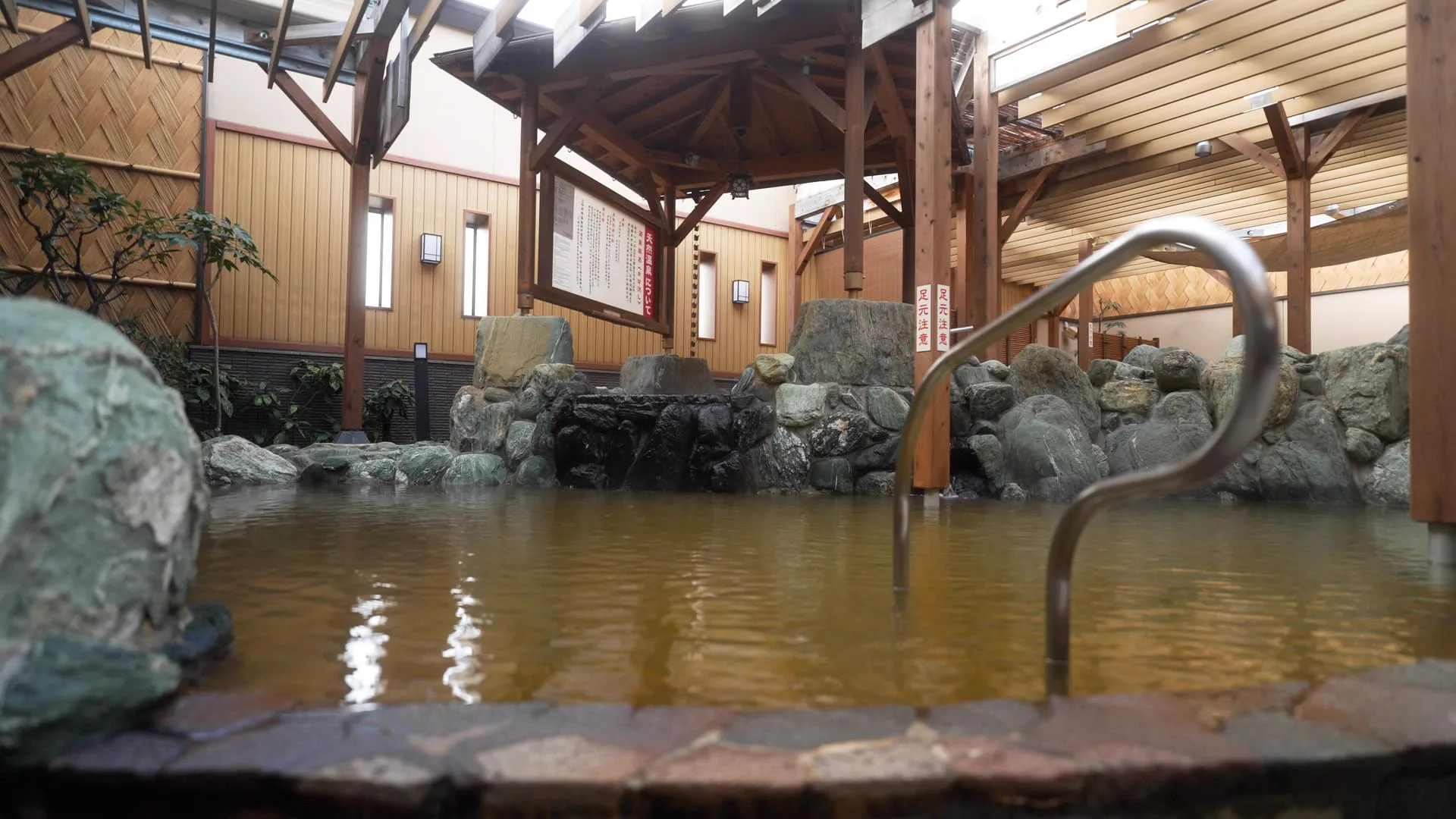
The operator describes its spring water as coming from granite and granodiorite layers and identifies the outdoor source bath and rock bath as natural spring baths with free-flowing water. Other baths on the property include carbonated water, jets and indoor options, but the facility does not describe every tub as a natural spring bath.
Ujina is also the easier pick if you want the bath to be one stop in a city day rather than the main event. It has a restaurant and a tatami rest area. There is no separate heated-room admission to plan around.
Choose Rakurakuen when the west side fits your route
Rakurakuen costs ¥50 more than Ujina at the standard weekday and weekend rates. Its spring is drawn from a granite layer about 1,100 metres underground; the operator reports a flow of 392 litres per minute and describes the water as a concentrated chloride spring. The published bath list includes 14 types, though that is a mix of spring, carbonated and other baths—not 14 separate hot springs.
The main extra is the Korean-style heated-room area, called Chimjilbang Hanjung-dong. Admission to it costs ¥800 on weekdays, ¥900 on weekends and holidays, or ¥1,000 during special periods, on top of the bath admission. It is not sold as a stand-alone visit, and children must be elementary-school age or older. If your plan is to bathe and leave, there is no reason to pay for it.
For visitors coming from Miyajima or staying around Hatsukaichi, Rakurakuen can avoid doubling back into the city. Its restaurant and relaxation services also make it the branch better suited to a longer stop.
The ticket difference matters more than the ¥50 gap
At either branch, the ¥500 bath-only ticket is for a limited bathing visit, not a discounted way to use the whole spa. It excludes the outdoor baths, sauna and cold plunge. At Ujina, the full ticket also allows same-day re-entry only on weekdays, and re-entry becomes invalid if you leave the building. The Rakurakuen visitor page does not list the same weekday re-entry provision.
Both branches provide shampoo, conditioner and body wash in the bathing area; towels are not included, so bring your own or rent or buy them there. Tattoos, including stickers and body paint, are not accepted under the published rules. Wheelchair use in the bathing area requires an advance weekday reservation and confirmation of the facility’s conditions; call the branch before planning around access.
If you want a natural-spring bath near Hiroshima’s center, Ujina is usually the simpler trip. If your hotel or itinerary is already west of town—and you want a heated-room area—Rakurakuen’s extra fare has a clearer purpose.
Sources
- Honoyu Ujina: [hours and admission](https://www.honoyu.jp/ujina/guidel/), [spring baths](https://www.honoyu.jp/ujina/onsen/), [access](https://www.honoyu.jp/ujina/access/) - Honoyu Rakurakuen: [hours, admission and heated-room fees](https://www.honoyu.jp/rakurakuen/guidel/), [spring baths](https://www.honoyu.jp/rakurakuen/onsen/), [access](https://www.honoyu.jp/rakurakuen/access/) - Honoyu Rakurakuen: [facility notices](https://www.honoyu.jp/rakurakuen/news/)Tags: Hiroshima, Ujina, Rakurakuen, day-use onsen, comparison