Kishigon Ryokan in Ikaho: Kogane-no-Yu, Rooms and the Stone Steps
See what Kishigon confirms about its Kogane-no-Yu baths, room layouts and stone-step location, plus the 2026–27 bath renovation and parking approach.
Kishigon is a strong choice when the spring itself and a room beside Ikaho’s stone-step street matter more than having a private onsen in your room. The inn says its public bathing facilities use Kogane-no-Yu without dilution or recirculation, and its entrance opens onto the steps.
There is one date-sensitive catch: the current notice schedules renovation of the first-floor Matazaemon bath from September 1, 2026, through January 31, 2027. During that period it is due to operate on a men’s-and-women’s rotation; the other two main baths are listed as open as usual. The inn warns that the schedule may change, so confirm the setup for your stay.
First check which baths will be available to you
Kishigon has three main bathing areas, each with a different feel. The separation matters more than the headline count of facilities, particularly during the current renovation window.
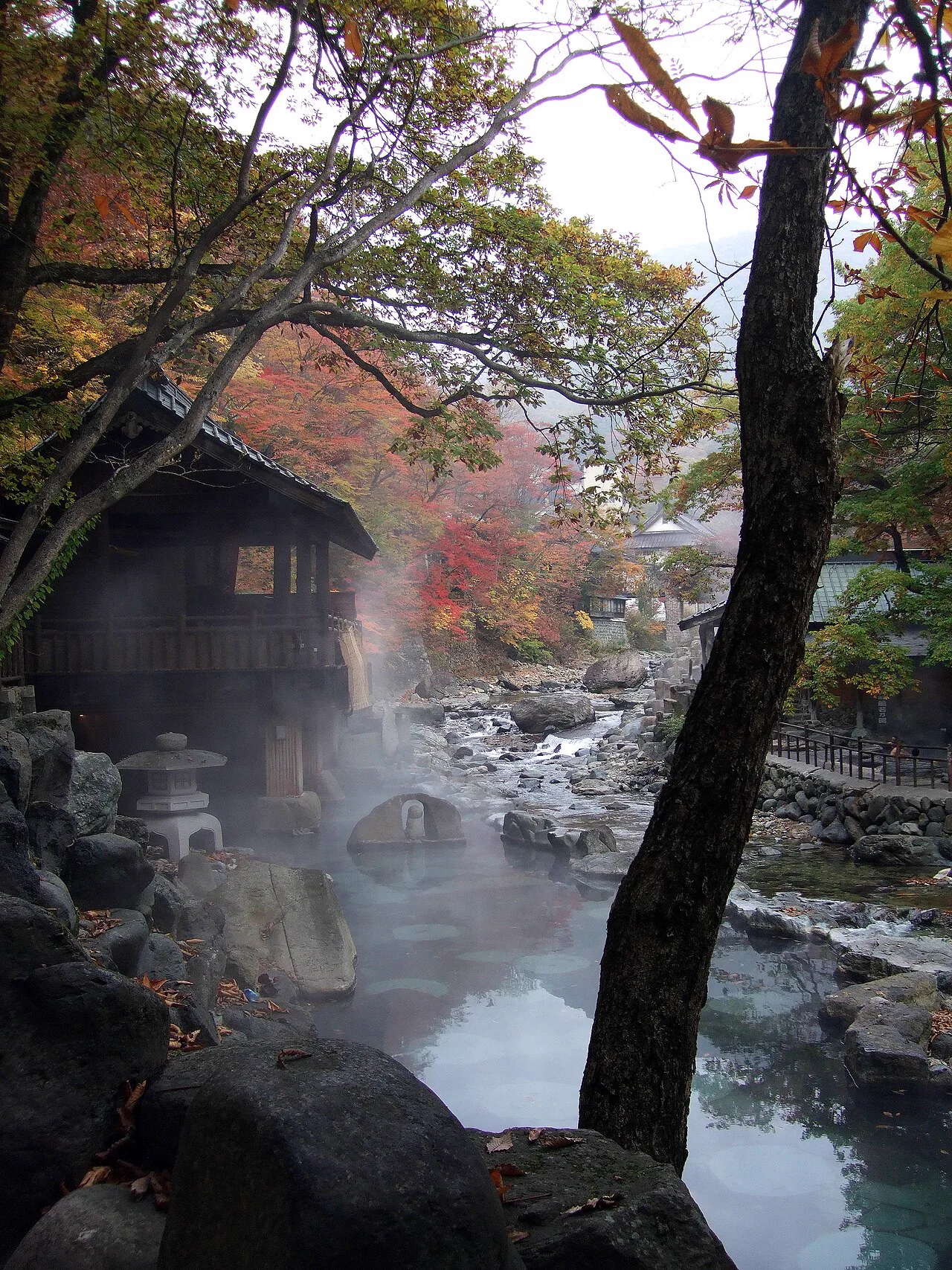
- Gonzaemon-no-Yu is the detached cypress outdoor bath across the road from the lobby. It is open 3–11 p.m. and 6–10 a.m.; there is no washing area or shower, so use another bath to wash first. The short crossing outside is part of the route, not an indoor connection.
- Rokuzaemon-no-Yu is the view-facing bath in the separate spa tower, with a glass-walled indoor pool, a smaller outdoor bath and a mist sauna. Its posted hours are 2 p.m.–2 a.m. and 5–10 a.m.
- Matazaemon-no-Yu is the older first-floor indoor bath, also posted for 2 p.m.–2 a.m. and 5–10 a.m. Under the renovation notice, guests use it on a gender-rotation schedule from September 1, 2026, to January 31, 2027—not as two simultaneously available men’s and women’s baths.
All the times above are the inn’s posted schedule; check its notice or ask directly before relying on a particular bath. Kishigon does not offer day-use bathing: public and paid private baths are for overnight guests.
Kogane-no-Yu is the reason to choose Kishigon for bathing. The inn describes a supply of just over 300 litres per minute and says its spring-fed baths are not diluted or recirculated. It also notes that the source emerges at a lower temperature and is heated in winter.
Those statements describe the inn’s hot-spring facilities; they do not establish that every private bathroom or tub in a guest room uses the spring water.
Three paid private baths opened in April 2026. Akagi and Ikaho are 45-minute sessions at ¥2,750; Fuchina is a 90-minute session at ¥4,400. Reservations are normally made at the dedicated desk after check-in. Wheelchair users and guests who need privacy for post-surgical scarring may request advance arrangements.
If a particular bathing time is central to your stay, factor in the usual same-day booking rule rather than assuming a slot is guaranteed.
Choose a room for the layout you will actually use
The room list ranges from compact Japanese rooms to a large suite, but the feature names do not make every category interchangeable. The official page does not identify any guest-room bath as a Kogane-no-Yu bath. If in-room spring water is essential, ask the inn about the exact room and water supply before booking.
| Room type | Useful details | Trade-off to know |
|---|---|---|
| 10-mat Japanese room | About 38.5 m², for one to five guests, with a bathroom; three variants are assigned by the inn | You cannot choose among the three variants from the general room description |
| 12-mat corner Japanese room | 48 m², for two to five, with a bathroom and views toward the Haruna or Akagi side | Only three rooms are listed; this category has 2 p.m. check-in and 11 a.m. checkout |
| View-facing modern twin | 38.5 m², for one or two, with two beds, a rain-shower booth and a mountain-facing outlook | The listed setup is a shower booth rather than a full bath |
| Low-step Japanese-Western room | Two beds plus a 10-mat Japanese area; one threshold at the entrance and otherwise described as flat | Only two rooms; no mountain view, and two bookings in this category may be on separate floors |
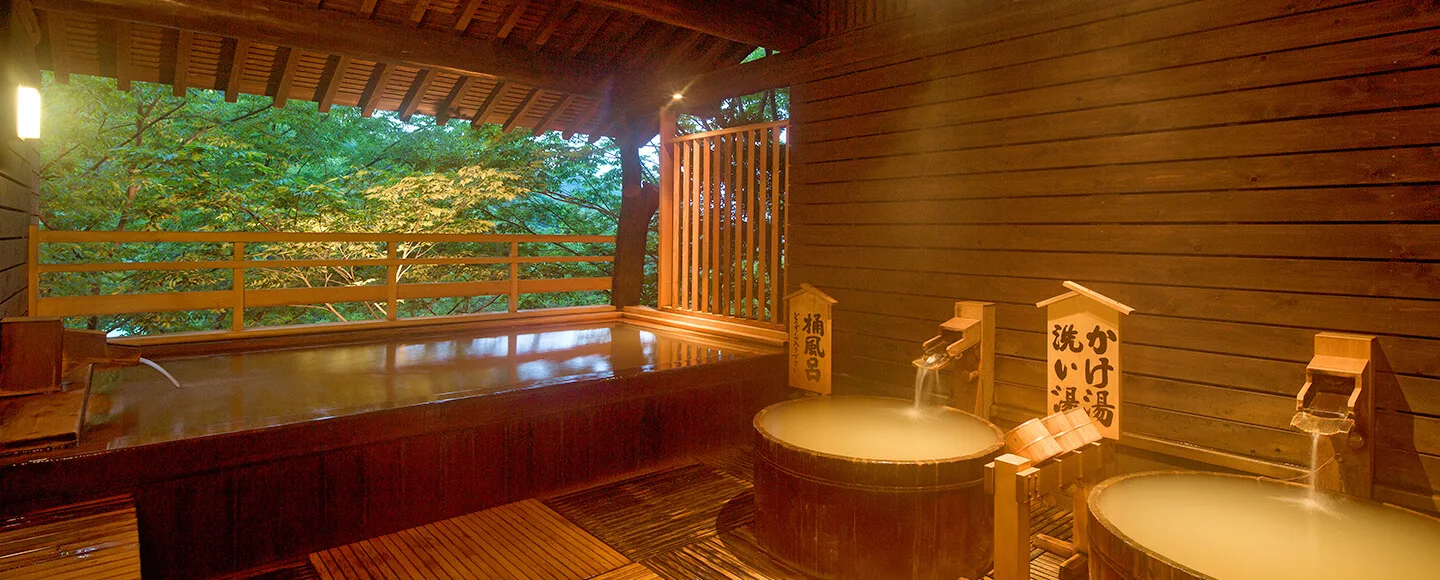
| Kakitsubata suite | About 87 m², two beds and a semi-open-air cypress bath | One room, not for children below elementary-school age, and there are five or six steps between the elevator lobby and room |
The low-step room can help someone who prefers beds or wants fewer thresholds inside, but Kishigon says it has no formally designated barrier-free guest room. Ask about the route from entrance to room, bath and dining area if mobility is a deciding factor. The suite’s semi-open-air cypress bath is a room feature, not proof of a private Kogane spring bath.
For guests choosing the inn chiefly for the shared source-fed baths, a standard room may be enough. Pay extra for a room category because its view, bed arrangement, space or schedule suits you—not because “bath” or “semi-open-air” appears in the description.
The steps are right outside, with the usual hillside cost
Kishigon sits in the middle-to-upper part of Ishidangai, according to its FAQ, and the stone street is directly in front of the inn. Shibukawa City describes the route from Dandan Square at the bottom to Ikaho Shrine at the top as 365 steps, lined with shops, places to eat and ryokan.
Staying here makes it easy to pop back to your room between a stroll and a soak; it does not make the district flat. The Ikaho stay-area guide compares this position with the lower and upper ends of the street.
If you arrive by local bus, the stop depends on the operator: Kishigon lists Ishidanguchi for Gunma Bus and Ikaho Onsen for Kan-Etsu Kotsu. Highway buses stop at Ikaho Ishidangai. The inn offers pickup from bus stops around Ikaho; call after you arrive rather than expecting collection at Shibukawa Station.
The inn’s access page gives about 20–25 minutes by local bus from Shibukawa Station to Ikaho and a further six-minute walk, but schedules and stop names can change. Check the current operator timetable for your travel date.
Driving has a separate wrinkle. Kishigon directs guests to its Fourth Parking Lot by Ikaho Elementary School and asks them to call when they arrive for pickup if no car is waiting.
The street at the entrance is very narrow, with a tight turn beneath the building; the inn recommends the lot for larger or low-clearance cars and asks drivers with less than 10 cm of ground clearance to contact it. Parking is free. This Tokyo-to-Ikaho transport guide covers the wider rail, highway-bus and driving choices.
Is Kishigon the right Ikaho stay?
Choose it when you want to spend time in Kogane-no-Yu and value being able to step straight into the historic street. Its baths are the main draw; the hilltop position suits travellers comfortable with stairs and a sloped approach.
It is a weaker fit if you want a guaranteed in-room hot-spring bath, a flat route through the property or easy daytime bathing without an overnight stay. During the currently scheduled renovation window, also be comfortable with Matazaemon changing between men’s and women’s use. If reservable private baths are the priority, Hotel Kindayu’s private-bath guide focuses on its different booking setup.
For a broader explanation of Ikaho’s spring choices, see Kogane-no-Yu vs. Shirogane-no-Yu.