Which Kyushu Onsen Should You Choose?
Compare Kyushu onsen areas by route: Beppu for public-bath variety, Yufuin for a ryokan stay, Kurokawa for outdoor baths, and Ibusuki for sand bathing.
Kyushu has no single onsen town that works as a stand-in for the whole island. Beppu is built for trying different baths; Yufuin makes more sense when the inn and a slow town walk are part of the point. Kurokawa is a mountain village where the outdoor baths are the draw, while Ibusuki has a sand-bath experience that is hard to substitute elsewhere.
Start with your arrival airport, whether you will drive, and how many nights you can give the hot-spring part of the trip. Those three choices usually narrow the map faster than comparing spring names.
| Area | Choose it for | What the trip asks of you |
|---|---|---|
| Beppu | Several types of public bath, steam cooking, sand baths and a choice of districts | Pick one or two areas each day; the options are spread across the city |
| Yufuin | A ryokan stay, private bathing and time to walk around town | Choose the inn first; properties vary in how easy they are to reach on foot |
| Kurokawa | A compact mountain village and outdoor-bath hopping | Give it time, and check the limited bus connections before booking |
| Ureshino | A slower Saga stay with onsen tofu and local tea | Better as an overnight or a stop on a western-Kyushu route than a quick detour |
| Takeo | Historic public baths and a short railway stop | Works well for a half-day or one night on the Nagasaki line |
| Unzen | Sulfur springs, volcanic scenery and a mountain setting | Allow for the approach across the Shimabara Peninsula; it is not a quick city soak |
| Kirishima | A spread of mountain springs near Kagoshima Airport | Pick a base or rent a car; the hot-spring area is not one walkable strip |
| Ibusuki | A naturally heated sand bath and the southern coast | Pair it with Kagoshima or a southern-Kyushu stay rather than squeezing it into a northern loop |
Match the destination to your travel style
For a first trip with no fixed preference: Beppu
Beppu’s eight hot-spring districts—Beppu, Hamawaki, Kankaiji, Horita, Myoban, Kannawa, Shibaseki and Kamegawa—give the city its range. A station-area bathhouse, Kannawa’s steam-cooking district and the hillside baths around Myoban feel like different outings. That variety is useful if bathing itself is the day’s main activity, but it can also tempt you to overfill the schedule. Pick a couple of stops rather than trying to “complete” all eight areas.
For a town-centred comparison, see Beppu or Yufuin? and the Beppu municipal-bath guide.
For an overnight built around the inn: Yufuin
Yufuin is a better fit when you want time for the ryokan, a walk through town and a bath before or after dinner. It is not simply a quieter version of Beppu: its strength is the stay’s rhythm, not the number of bathhouses you can visit. Look at the exact property, bath and source-water details rather than assuming every place labelled “Yufuin Onsen” offers the same setup.
For an outdoor-bath circuit: Kurokawa
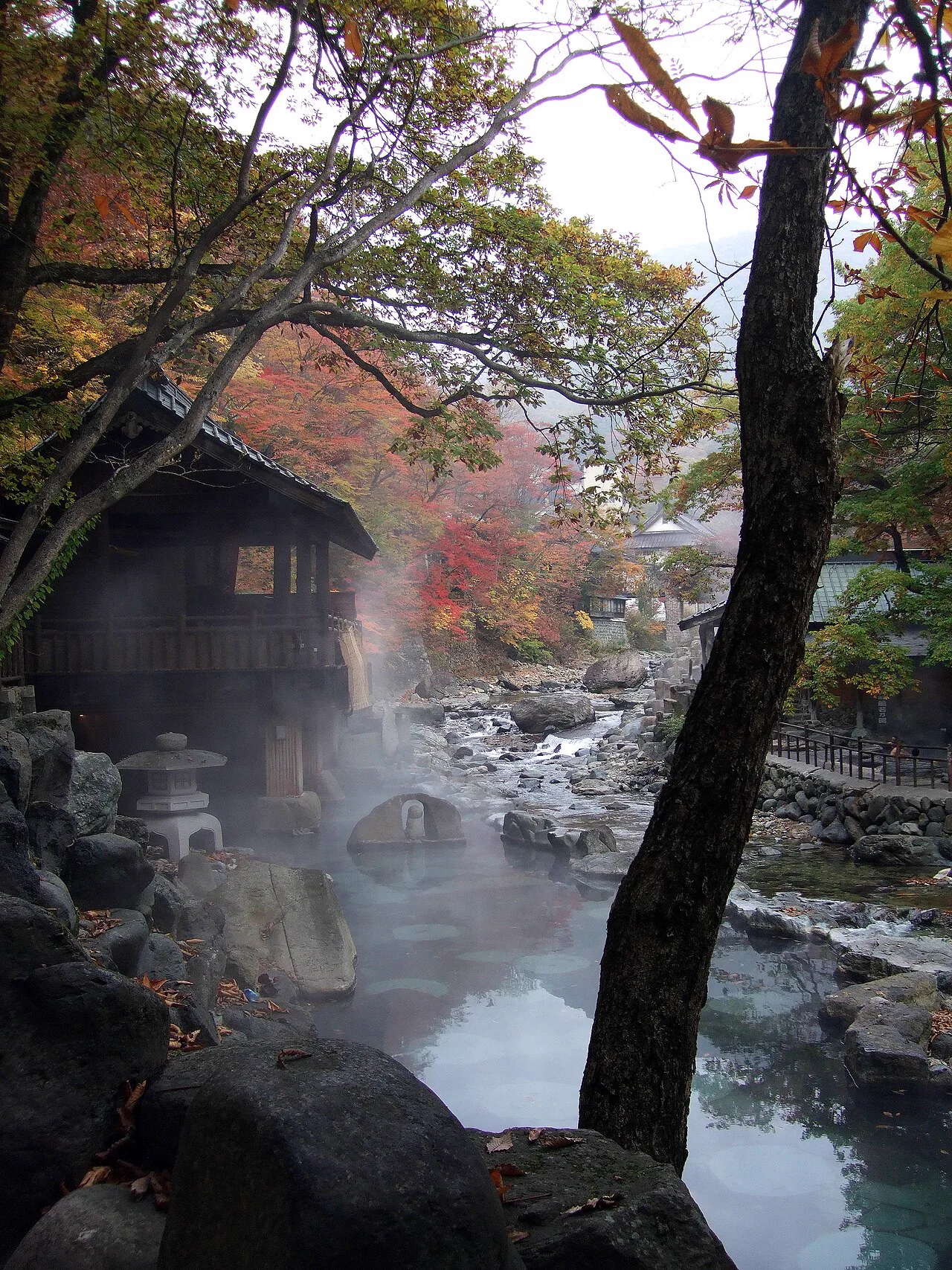
Kurokawa’s outdoor baths are spread among ryokan around a small mountain village. The Nyuto Tegata bathing pass is designed for visiting baths at participating inns, but opening and day-use access can vary by property. Kurokawa is easiest to enjoy when you arrive with enough time to settle in, not as a rushed stop between Aso and another town. Without a car, confirm the bus you will take before choosing your lodging.
See the Kurokawa day-use private-bath guide if you need a bath for your own group rather than a shared outdoor pool.
For a western-Kyushu rail route: Ureshino or Takeo
Both sit in Saga Prefecture and can be combined with western-Kyushu travel, but they do different jobs. Ureshino leans toward an overnight ryokan stay, local tea and onsen tofu. Takeo is more suited to a shorter stop around its historic gate and public baths. You do not need to stay overnight in both simply because they are nearby; decide whether the trip needs an extra night or a few hours between trains.
For mountain scenery or a distinctive bathing experience
Unzen combines sulfur springs with the Jigoku geothermal area and a highland setting. Its appeal is the whole mountain destination, so account for the journey across the peninsula and consider staying overnight.
Kirishima Onsenkyo is a collection of springs at roughly 600–850 metres above sea level, with varied spring types. The area suits a car-based trip or an overnight near the airport; it is too spread out to treat as one continuous onsen street. Kirishima or Ibusuki? compares the two Kagoshima-area choices.
In Ibusuki, the naturally heated sand bath is the main point of difference. It makes a good half-day or overnight on the Satsuma Peninsula, especially if Kagoshima City is already on your route. The first-timer’s guide to Ibusuki sand bathing covers what to expect at the facility.
Choose the route by transport and trip length
Without a car, Beppu and Yufuin make the easiest first pair. Trains and buses connect the area, while the two stops offer a city of public baths and a slower, inn-led stay. In western Kyushu, Takeo or Ureshino can fit a Saga–Nagasaki rail itinerary, though Ureshino Onsen Station is not beside the old hot-spring district.
Kurokawa is reachable by bus, but check and reserve the service before booking; it works best as a stay, not a hurried stop between regions. Farther south, Kagoshima City and Ibusuki make the clearest rail pairing. For car-free Kirishima, choose an inn with a useful bus stop or guest pickup before planning individual baths.
Driving opens up spread-out areas such as Kirishima and makes mountain legs easier, but it does not make the island small. Keep one main onsen area per day. A Fukuoka-to-Kagoshima trip can move south through Beppu or Yufuin, Kurokawa or Aso, Kumamoto, Kirishima and Ibusuki; choose fewer overnight bases if bathing time matters more than collecting place names.
If you have only a few nights
With three nights and no firm preference, Beppu for two nights plus Yufuin for one is the simplest first trip. Couples who want a mountain-ryokan stay can swap in Kurokawa, but only if the bus schedule and luggage changes feel manageable; otherwise, spend all three nights in one area. For a western-Kyushu trip, choose either Ureshino or Takeo for one night and leave two nights for Nagasaki. In the south, a car makes one night each in Kirishima, Kagoshima City and Ibusuki workable; without one, check every rail and bus connection first.
For five to seven days, decide first whether the trip is built around a rental car or public transport. The seven-day self-drive loop uses mountain roads to join smaller areas; Kyushu without a car is organised around train and bus departures. With seven nights or more, it becomes easier to combine two or three distinct experiences—say, Beppu’s public-bath variety, Kurokawa’s outdoor-bath circuit and Ibusuki’s sand baths. Break up consecutive high-priced ryokan stays with a city night if the daily rhythm starts to feel repetitive.