Haraigawa Onsen vs Yamaidashi Ikoi no Sato: Which Nanyo Bath Fits Your Trip?
Choose Haraigawa for its sulfur spring and low-cost private bath, or Yamaidashi for public and family baths, lodging and a campground. Both are rural stops.
Haraigawa Onsen is the better fit if you are going for its sulfur spring and inexpensive private bath. Yamaidashi Ikoi no Sato makes more sense when the bath is part of a longer family stop: it has two public baths, reservable family rooms, overnight rooms, cabins and a campground. Both sit well outside the main cities, so the drive—or the last bus—matters as much as the water.
The practical differences
| Haraigawa Onsen, Uwajima | Yamaidashi Ikoi no Sato, Ainan | |
|---|---|---|
| Spring | Simple sulfur cold mineral spring; Uwajima’s tourism association says spring water reaches the baths and taps | Low-salinity, weakly alkaline cold mineral spring; the operator describes its public baths as source-flow |
| Adult day admission | ¥450 | Official listings disagree: ¥550 on the operator and prefectural tourism pages; ¥650 on Ainan Town’s page |
| Hours | 10 am–8:30 pm; last entry 7:30 pm | 10 am–9 pm; last entry 8:30 pm |
| Regular closure | Thursday and year-end holidays on the latest city page; the tourism-association listing also names the 1st and 20th of each month | Wednesday; open when Wednesday is a public holiday |
| Private bath | Three detached family baths; ¥1,200–¥1,350 per 50 minutes | Two family baths; ¥1,800 on the operator page or ¥1,850 on the town page for 50 minutes |
| Beyond bathing | Modest mountain bathhouse, with nearby rural walks and activities | Japanese-style rest room with private bath, guest rooms, log cabins, campground, dog runs and a Saturday local-food buffet |
| Without a car | Possible on weekdays with a long transfer and a tightly timed community bus | Not a straightforward public-transport stop; confirm a route or arrange a car/taxi |
For the wider Nanyo picture—including nine baths across Uwajima, Ainan, Seiyo and other towns—see the Ehime Nanyo day-onsen comparison. Here, the useful question is more specific: which of these two remote facilities fits your route and the kind of bath you want?
If your trip continues north toward Matsuyama, the city onsen and sento guide covers a very different, transit-friendly set of baths.
Haraigawa: a sulfur spring worth planning around
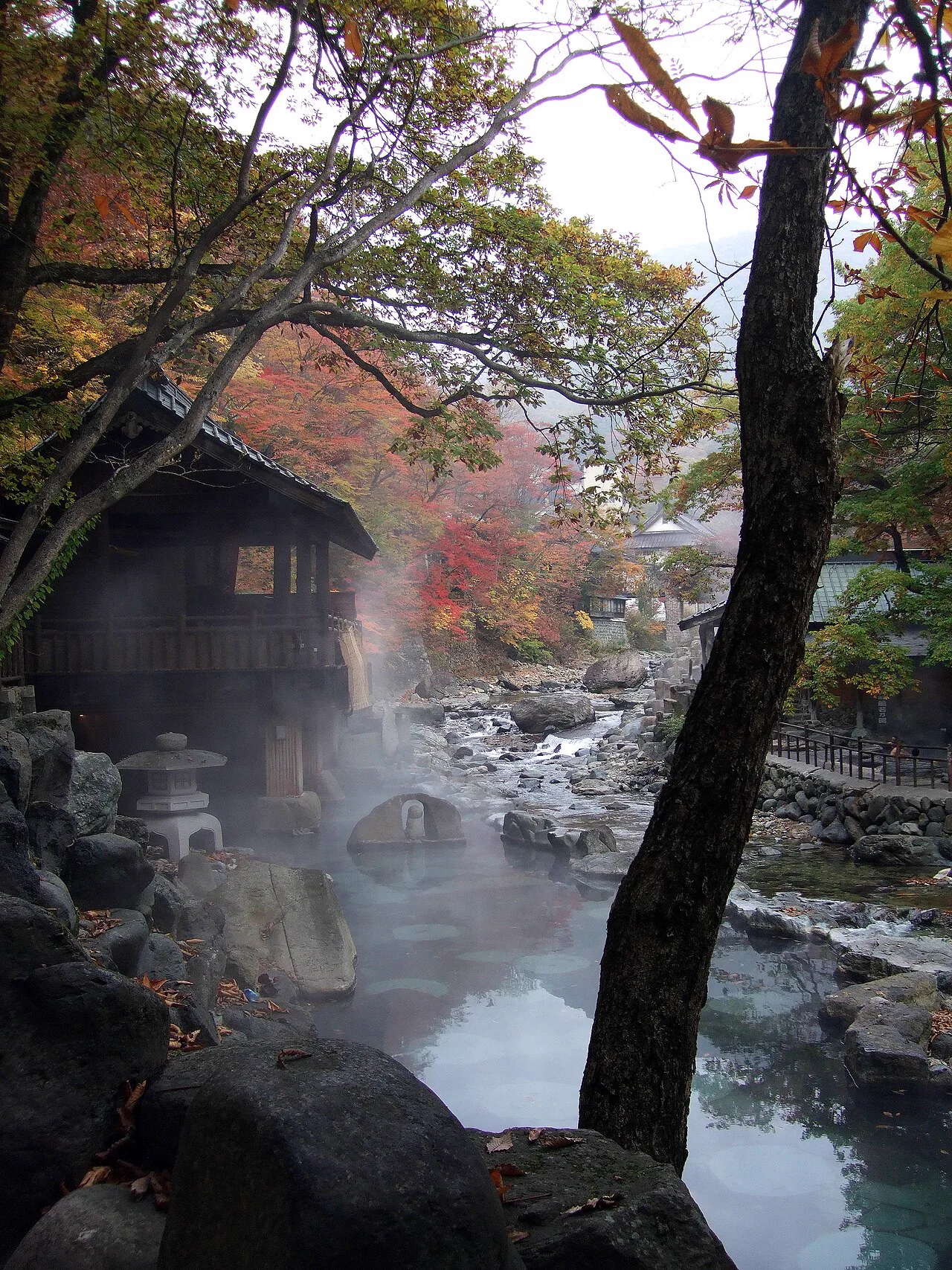
Haraigawa sits in the mountains of Tsushima, about an hour by car from central Uwajima, Ainan’s town centre or Sukumo in Kochi Prefecture. The draw is specific: Uwajima City classifies the water as a simple sulfur cold mineral spring, and the Uwajima tourism association describes source-flow water coming through both the baths and faucets. Adult admission is ¥450; children through elementary school pay ¥150, and visitors aged 65 or older pay ¥350.
There are two ordinary baths, Sakura and Ume, and three separate family baths: the smaller Sagisō and Rindō rooms cost ¥1,200 for 50 minutes, while the larger Momiji room is ¥1,350. These are room charges, not per-person rates. The separate rooms make Haraigawa the cheaper choice for a couple or family who need privacy, though the basic facilities are more modest than a full resort spa.
The available pages do not provide a complete source analysis with temperature, pH or flow rate. “Cold mineral spring” describes the source category, while the tourism association’s source-flow description concerns how water is supplied.
Check the closure dates before a long drive
Uwajima City’s facility page, updated on 1 August 2026, lists Thursdays and 31 December–1 January as regular closures. The Uwajima tourism association’s page still lists the 1st and 20th of each month as well. Because the two local sources disagree, call Haraigawa at 0895-36-0333 before travelling—especially if your visit falls on the 1st or 20th. The tourism association also warns that a spring-equipment fault can cause an unscheduled closure.
Yamaidashi: a place to stay, not just a bath
Yamaidashi is in the hills of Ainan, beside the Sōzu River. Its water is classified as a low-salinity, weakly alkaline cold mineral spring. The operator highlights source-flow water in its two public baths, Keiyu and Ukake-yu. Their use switches by day: Keiyu is the men’s bath on weekdays and women’s bath on weekends and public holidays; Ukake-yu works the other way around. If you are hoping to use a particular side, check the calendar rather than relying on a photo from another day.
The bigger distinction is how the grounds are set up. Each of the two family baths combines a rock bath with a six-tatami Japanese-style sitting room, washbasin and toilet. The listed capacity is three adults, or two adults plus two children up to junior-high age. That room is useful for changing or resting with children, and explains some of the price gap: this is more than a tub booked by the hour.
Yamaidashi also has three guest rooms, three log cabins, a campground and two dog runs. The operator publishes these guest-room and meal rates:
| Item | Published rate | Detail |
|---|---|---|
| Guest room, one person | ¥7,000 | Each additional adult is ¥5,000; elementary-school children are ¥4,000 |
| Breakfast | ¥800 per person | Dinner is ¥1,000 per person |
| Log cabin, one person | ¥4,000 | ¥3,500 each when shared by two or more; elementary-school children are ¥2,500 |
Check-in is listed at 5 pm and checkout at 10:30 am. The guest rooms have private bathrooms, but the room page does not identify them as hot-spring baths.
On Saturdays, the restaurant serves an Ainan-produce buffet from 11 am to 2 pm, with reception closing 30 minutes before the end. Weekday meals are by reservation only. The bath itself closes at 9 pm, with last entry at 8:30 pm; Wednesday is the regular closing day, except when it is a public holiday.
Yamaidashi’s published prices differ by source:
| Source | Adult admission | 50-minute family bath |
|---|---|---|
| Ainan Town | ¥650 | ¥1,850 |
| Facility and Ehime tourism listing | ¥550 | ¥1,800 |
The operator has not resolved the difference on its listed pages. Budget for the higher amount and call 0895-72-6263 to confirm the fee and reserve a family room.
Getting there without a car
Haraigawa has a published—but limited—bus option. Uwajima City lists a trip from Uwajima Station to Iwamatsu in Tsushima at about 30 minutes, followed by roughly 40 minutes on the Tsushima community bus. That second leg runs on weekdays only, with five services a day.
The city’s sample itinerary shows a bus leaving Iwamatsu Community Centre at 11:30 am and reaching Haraigawa at 12:10 pm; the listed return leaves the bath at 3:08 pm and reaches Iwamatsu at 3:48 pm. Check the linked community-bus timetable and service notices for your date, then match them against the Uwajima train or highway-bus connection. Missing the return is not a minor delay in this mountain area.
Ainan operates local buses, but neither the town nor the facility’s access page gives a simple, verified stop-to-door connection for Yamaidashi. If you are set on visiting without a car, ask the facility which stop to use and confirm the return service before you commit. Driving is the easier plan for either bath; Yamaidashi’s operator estimates about 30 minutes from Tsushima-Iwamatsu Interchange via Route 56, while Haraigawa is around 50 minutes from Tsushima-Takata Interchange.
Choose by the day you want
Choose Haraigawa when the sulfur spring, a low admission price or an inexpensive private bath is the point of the trip. Treat it as its own mountain outing, allow at least an hour for the drive from Uwajima and 60–90 minutes at the bath, and plan the return before dark. Its weekday bus link is possible, but the small number of departures makes the visit hard to improvise.
Choose Yamaidashi when you are already travelling around Ainan or want the option to stay overnight or camp. The private bath’s adjoining sitting room changes the value for families, and the Saturday buffet can anchor a longer stop. The ticket-price discrepancy is unresolved, and a car or carefully planned taxi connection is still the sensible way to reach it.
For a half-day, keep the stops in their natural route clusters: give Haraigawa a 60–90-minute bathing window before the return drive; use Yamaidashi as part of an Ainan coast, campsite or cabin stay. Travelling between them just to compare baths adds a long rural drive without solving the return-transport problem.
Neither facility currently publishes a clear tattoo policy on the pages checked here. If that affects your visit, contact the bath directly. If your route is centred on Matsuyama rather than southern Ehime, the Dogo day-use bath guide covers options closer to the city.
Sources
- Uwajima City, [Haraigawa Onsen: hours, current prices, access and closure information](https://www.city.uwajima.ehime.jp/soshiki/22/haraigawa-onsen.html) - Uwajima Tourism and Local Products Association, [Haraigawa Onsen: spring details, hours and additional closure listing](https://www.uwajima.org/onsen/haraigawa.html) - Uwajima City, [Tsushima community-bus route, sample itinerary and service information](https://www.city.uwajima.ehime.jp/soshiki/3/komibasutsushima.html) - Yamaidashi Ikoi no Sato, [Onsen, bath schedule and operator-listed fees](https://yamaidashi.com/onsen/) and [access and opening information](https://yamaidashi.com/access/) - Yamaidashi Ikoi no Sato, [guest rooms, log cabins, meals and camping fees](https://yamaidashi.com/tomaru/) - Ainan Town, [Yamaidashi Ikoi no Sato: facility, current listed fees, family-bath capacity and accommodation](https://www.town.ainan.ehime.jp/kanko/sightseeing/shukuhaku/ikoinosato-onsen.html) - Ehime Prefecture, [Yamaidashi Ikoi no Sato listing](https://www.iyokannet.jp/spot/744/) - Jalan, [Yamaidashi Ikoi no Sato listing and reviews](https://www.jalan.net/kankou/spt_38503cd2110077274/) (two reviews; too small a sample to support general claims)Checked: 2026-09-27