Tsunashima Yukemuri no Sho: Dark Spring, Sauna and Access
Plan a Tsunashima Yukemuri no Sho visit: prices, spring water, sauna and access.
The dark water is the headline at this Yokohama bath complex. Its sodium-bicarbonate source feeds outdoor pools, while a sauna, stone spa and roomy lounges turn the visit into a half-day plan. The free station shuttle carries only a small group, and the walk from either nearby rail stop takes roughly twenty minutes, so this is not a quick platform-side soak.
One seasonal feature is still running as of October 24, 2026. The operator’s notice says the unheated source-water bath is available through October 31. That date matters; it is not part of the year-round lineup.
What the ticket includes
| Adult admission | Weekday | Weekend or public holiday |
|---|---|---|
| Bath entry | ¥1,540 | ¥1,700, plus ¥100 bathing tax |
| Bedrock-bath add-on | ¥880 | ¥990 |
| Bath and bedrock together | ¥2,420 | ¥2,790 including the bathing tax |
The entry fee comes with two towels and indoor clothes. Public bathing runs from 9 a.m. until midnight; the front desk stops admitting guests at 11 p.m., and the stone spa also shuts at that hour. Re-entry to the pools is allowed while your admission is active; once you exit the building, that ticket is spent. A short dip may not justify the long-stay extras. The add-on fits better when there is time for a meal or a proper rest between bathing rounds.
Dark water, plus one short-lived bath
The source is classified as sodium bicarbonate mineral water. The published test gives it a pH of 7.7, and the well yields 240 litres each minute. Its natural colour ranges from dark brown to almost black. “Cold spring” describes the water underground, not every pool in the building: a source-water tub sits beside heated baths.
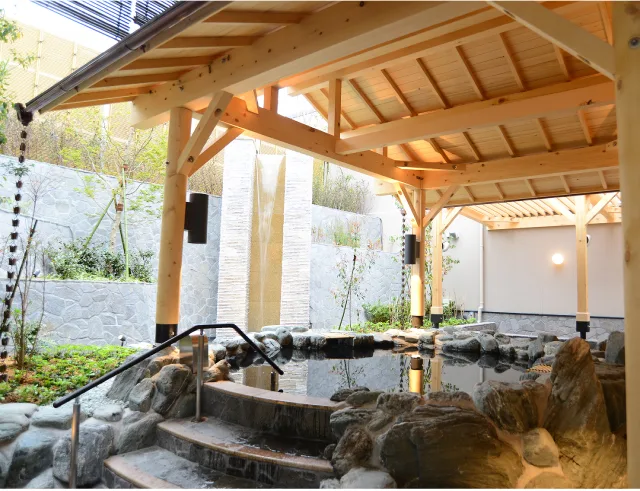
Until October 31, a seasonal tub is being filled directly from the source without heating. No water temperature is posted for the event, so expect a cooler dip rather than a guaranteed figure. Elsewhere, the lineup spans twelve spring-fed pools: an open-air rock bath, a reclining tub and a standing pool on the women’s side among them. See the operator’s bath guide for the current configuration.
There is a self-serve löyly sauna, with scheduled sessions varying between the men’s and women’s areas. The six-bedrock-bath rooms, restaurant and relaxation spaces are shared, while the bathing areas remain gender-separated. If you want a simpler option by a station, Manten no Yu at Kami-Hoshikawa is easier to fit into a short Yokohama outing; the Yokohama day-onsen guide compares other city choices.
Getting there: do not count on the shuttle alone
From Tokyu Tsunashima Station, the walk is about 18 minutes; from Shin-Tsunashima Station on the Sotetsu–Tokyu Shin-Yokohama Line, it is about 17 minutes. A free shuttle serves both stations, but its vehicle seats only nine people and can depart once full. Crowds and road traffic make it a poor single plan if you have a train connection to make.
There is also a local-bus option from Shin-Tsunashima. Rinko Bus route 51 leaves from stop 2 at the south exit; Yokohama Municipal Bus route 13 leaves from stop 3. Both serve Tarunoya, about a minute from the entrance. Check the operators’ current timetable before leaving the station. Drivers have more than 200 spaces; bathing guests receive three hours free, then pay ¥220 per 30 minutes up to ¥1,100 for the day. A bath, sauna and meal can take longer than the free period.
For another Yokohama bath with straightforward station access, see Spa Eas or the Ryusenji Spa Hills guide. If you are comparing other dark-water baths, Kamata’s black-water onsen guide explains how Tokyo’s kuroyu differs from Tsunashima’s published spring classification.
Rules to check before paying
Only elementary-school-age children and older may enter. Children aged seven and above, including younger children at least 120 cm tall, cannot use the bath for the opposite sex. Bedrock bathing is limited to middle-school age and older. Tattoos, including stickers and henna, are prohibited; the facility says guests found with them may be asked to leave. It does make an exception for a purpose-made bathing cover after breast-cancer surgery.
Guests who need a facility with a different policy should verify it directly before travelling. For other regional alternatives, compare Yuttari Coco in Miyamaedaira and Kawasaki’s day-use onsen options. Anyone focused on tattoo rules can also read the Kawasaki tattoo-bathing guide. The Yokohama day-onsen guide compares other city choices.
Sources
Checked October 24, 2026. The raw-spring event is listed through October 31, 2026; later dates need a fresh check. Prices below are the operator’s current published rates. - [Tsunashima Yukemuri no Sho: admission and hours](https://www.yukemurinosato.com/tsunashima/) - [Spring and bath lineup](https://www.yukemurinosato.com/tsunashima/hotspring/) - [Access, shuttle, buses and parking](https://www.yukemurinosato.com/tsunashima/access/) - [FAQ and facility rules](https://www.yukemurinosato.com/tsunashima/faq/) - [Raw-spring bath event through October 31, 2026](https://www.yukemurinosato.com/tsunashima/event/6428/)Last verified: 2026-10-24
