Irifune Onsen near Shin-Imamiya: Early Baths and Luggage Storage
Fit Irifune Onsen into an Osaka travel day with early opening hours, station walks, luggage handling, sauna rules, tattoo policy and current-price checks.
Irifune Onsen opens at 6 a.m. on operating days, close to JR and Nankai Shin-Imamiya and Osaka Metro’s Dobutsuen-mae. It can work between checkout and a train: the front desk accepts suitcases, and its FAQ says tattoos are permitted. The operator describes soft-water baths and a sauna; it does not identify the facility as a natural hot spring.
| Visit detail | Current operator information |
|---|---|
| Weekdays | 6 a.m.–11 p.m.; last reception 10:30 p.m. |
| Saturday and Sunday | 6 a.m.–midnight; last reception 11:30 p.m. |
| Weekly closure | Monday, including public holidays |
| Nearby stations | JR Shin-Imamiya and Metro Dobutsuen-mae, about 3 min; Nankai Shin-Imamiya, about 4 min |
| Luggage | Staff can hold suitcases; hand valuables to reception |
| Tattoos | Accepted according to the operator FAQ |
A useful stop after checkout
The bathhouse is in Haginochaya, a short walk from the Shin-Imamiya rail hub. Follow the operator’s access directions from the relevant station exit; the walk is slightly longer from Nankai than from JR or Dobutsuen-mae. There is no customer parking, so arriving by rail is simplest.
Reception can hold a suitcase that will not fit in a locker. Give valuables directly to staff: the operator’s FAQ limits its responsibility for belongings that have not been handed over. This is useful for a short gap before a departure, though it does not provide daytime access to your bag. For a day out, hotel storage or a station locker may be more practical.
Sauna rules and current charges
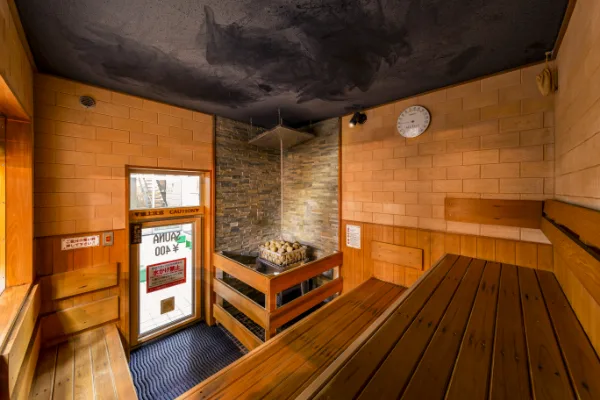
Irifune lists automatic löyly and staff-led aroma sessions. Sauna rooms are small, with capacity around ten per room; the operator bars children under 12 from sauna use and requires its own designated sauna towel. A personal towel does not replace the facility towel. Shampoo and body wash are supplied in the bathing area.
The current price page presents its basic admission and add-ons as images, so the amounts cannot be reliably read from its text. The operator confirms a separate sauna charge, but the live total is best checked at the ticket machine or counter. A notice on the official site reports an ¥680 admission for a specific event; do not mistake that event price for the ordinary tariff. Sauna pricing and occasional events may change.
Arriving at last reception leaves little time for washing, bathing and a sauna round. Use the weekday cutoff of 10:30 p.m. or weekend cutoff of 11:30 p.m. as the latest entry point, not as a recommended arrival time.
For more early or late options, compare the Osaka morning and late-night sento guide and Shin-Imamiya Wako Yokujo. Other nearby references include the Nishinari sento overview, Dobutsuen-mae Wako and Nobeha Tsuruhashi. If you prefer a natural-spring bath, use the Osaka day-use onsen guide to compare different facilities. Other city options include Abeno’s public baths and the Naniwa no Yu guide.