Private Baths in Higashiyama Onsen: In-Room, Reserved or Shared?
Compare Higashiyama’s in-room spring baths, reservable private baths and shared public pools; check the room category and water source before booking.
Checked: September 27, 2026
The first question is not whether a bath looks secluded; it is how you get to use it. A room bath is available on your schedule. A reservable bath is private for a fixed session. A shared public bath is the most flexible in opening hours, but it is not private. Those distinctions matter when a family’s dinner, children’s bedtime or shuttle arrival leaves only a short window.
Harataki’s four reserved baths
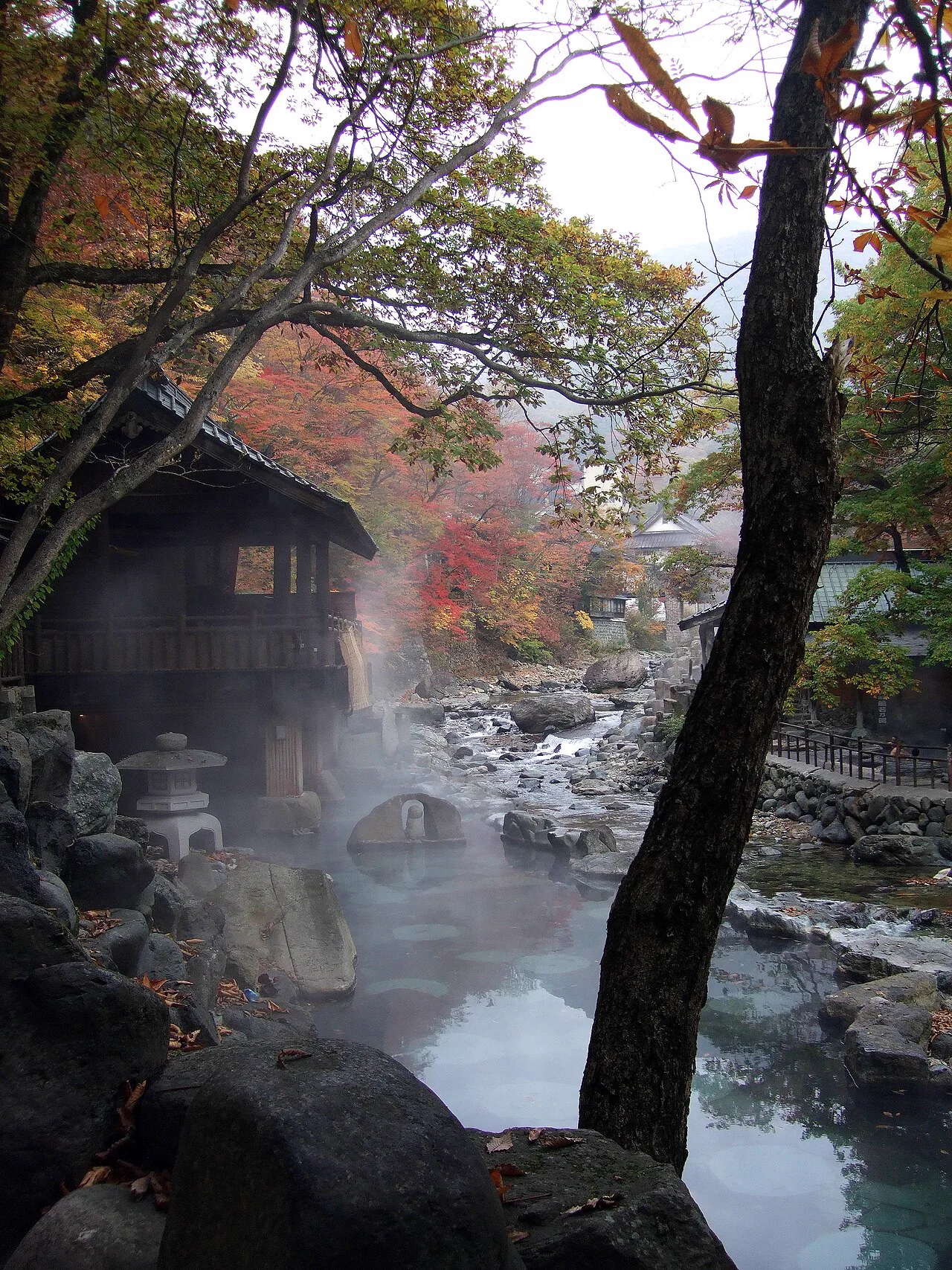
Harataki has four private scenic baths, each booked as a 50-minute session. The operator lists the current fee at ¥2,200 per room, tax included. The rooms differ in tub and setting: Takimi-no-Yu has a large Aomori hiba tub above the waterfall; Tsukimi-no-Yu has two rounded Shigaraki ceramic tubs; Yukimi-no-Yu pairs a hiba tub with a tatami floor; Hoshimi-no-Yu has two hiba tubs, one arranged for reclining.
All four are supplied by Harataki’s own spring. The operator’s overview lists the source as a sulphate spring at 56.5°C and says its outdoor bath is 100% source-flowing. Do not turn that statement into a claim about every other bath in the district.
These reserved baths suit a couple or family who can make a set time. They are less flexible if dinner, a bus arrival or a child’s sleep schedule is already tight. Book directly with the inn and confirm availability for the day.
The room bath is a different purchase
Harataki also sells specific guest-room categories with a private panoramic bath drawing from its own source. The operator describes the bath as a hinoki tub overlooking the gorge. That is a room feature, not a standard amenity across all 66 rooms. Compare the room name and description on the booking page before paying a premium; a gorge-facing room without the private spring bath is a different product.
For a room bath, the value is time flexibility: a quiet soak before dinner or after the public baths close. For the reserved baths, the value is the scenic setting and exclusive use for one short session. Neither option automatically includes the same room size, meal plan or view elsewhere in the inn.
When the shared bath is enough
Harataki’s public and outdoor baths are open to hotel guests, with cleaning time for the large bath from 10 am to 12:30 pm. The outdoor bath runs from 5 am to 11 pm. If privacy is not essential, this gives more time to bathe without coordinating a booked slot. The inn’s public and outdoor bathing areas do not allow tattoos; its official English guidance says guests with tattoos can use the private panoramic bath.
Onyado Toho’s two large bath areas are public and alternate between men and women on a schedule. Its room descriptions should be read category by category; a bathroom in a guest room is not necessarily a natural spring bath. The budget-stay comparison weighs the cost of a special room against meals and transport, while the day-bath comparison covers hotel bath entry windows.
| Need | Better fit |
|---|---|
| Bathe whenever your schedule allows | A room category that explicitly includes an onsen bath |
| One private soak with a gorge view | Harataki’s reserved scenic bath, subject to a booking slot |
| Longer access without a separate booking | The inn’s shared public bath |
| A specific spring analysis | The named bath or room must be tied to that source on the property page |
Four questions before you pay for privacy
- Does the room page explicitly say the bath uses hot-spring water, or does it only describe a tub, an open-air bath or a view?
- Is the private bath included, charged separately, or limited to a reserved 50-minute session?
- Can everyone in your party use it at the same time, and will that slot work around dinner, the bus and children’s bedtime?
- Does the water-treatment statement apply to this named bath, or only to another bath in the same inn?
If your main reason for wanting privacy is to avoid the public bath, the room bath usually gives the most control over timing. If you mainly want Harataki’s gorge setting, a reserved scenic bath is a lower-cost way to get one private session; the public bath remains more flexible when the 50-minute slot would collide with the rest of the evening.
Guests with tattoos should also read each inn’s own bathing rules. Harataki’s official English page allows its private panoramic bath, but that does not make its public baths tattoo-friendly.
The onsen association’s sulphate classification and Harataki’s 58.0°C source analysis are background for this district and this property respectively. Neither establishes the actual tub temperature in another inn’s private room. When the room page does not identify a spring source, describe it as a private bath, not a private onsen.