Tokinoirodori Inagi: Which Baths Are Kakenagashi?
Tokinoirodori: two spring baths flow freely, ¥1,000 weekday entry, station walk.
The kakenagashi label at this Inagi spa applies to two outdoor pools: a stone-lined bath and a shallow platform where bathers recline in flowing water. Other tubs either recirculate the spring or draw from a well. The distinction is useful here because the facility has several bath types under one roof.
Find the source water in the outdoor area
Water is drawn from 1.7 kilometres below ground and classed as a sodium bicarbonate-chloride spring. At the source, the listed temperature is 40.4°C; the flow is 308 litres per minute and pH is 7.84. In the reclining pool, the water runs in a shallow sheet beneath you, while the stone bath keeps the spring outdoors in a conventional tub.
| Bath | Water supply |
|---|---|
| Outdoor rock bath | Source, kakenagashi |
| Outdoor reclining bath | Source, kakenagashi |
| Outdoor relaxing bath | Recirculated source water |
| Spring carbonated bath | Recirculated source water with carbon dioxide |
| Irodori seasonal bath | Circulated well water |
| Indoor jet, electric and reclining baths | Circulated well water |
Carbon dioxide is added to recirculated spring water in the indoor carbonated pool, so it belongs in the spring-water group but not the kakenagashi pair. It returned to operation on October 14, 2026. Sauna options are an automatic-löyly room and a herbal steam room with mud and salt.
Admission and timing
| Visit detail | Weekday | Weekend / holiday |
|---|---|---|
| Adult admission, junior-high and older | ¥1,000 | ¥1,200 |
| Child admission, under junior-high age | ¥520 | ¥680 |
| Bedrock bath add-on | ¥750 | ¥850 |
| Bath opening | 9 a.m.–1 a.m. | 7 a.m.–1 a.m. |
| Last admission | Midnight | Midnight |
Admission includes use of the baths until departure; re-entry is not allowed once you leave. The bedrock bath is an optional add-on for junior-high age and older, includes clothing and a mat, and takes last entry at 10:30 p.m. The facility supplies shampoo, conditioner and body wash; a towel set costs ¥320.
Weekends after lunch are the busiest period, and the facility may limit entry when crowded. Tattoos, including stickers, are prohibited. Children who still use diapers or training pants cannot enter the changing room or bathing area; children below elementary-school age need an adult with them. The regular maintenance closure falls on the third Tuesday of March, June, September and December.
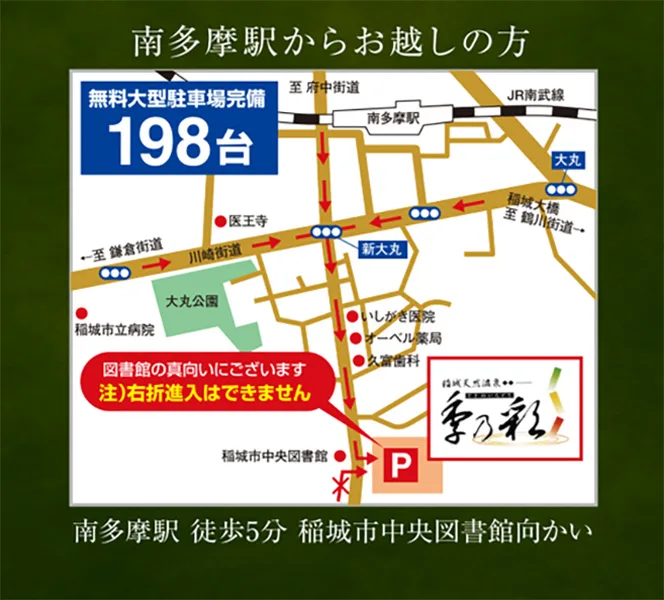
Five minutes from Minami-Tama Station
From JR Nambu Line’s Minami-Tama Station, walk about five minutes to the entrance. Keio, Odakyu and community buses stop at Shiroyama Park, close to the facility. This is one of the easier natural-spring visits from central Tokyo by rail, with no station shuttle to coordinate.
For an urban sento with sauna and café, try Koganeyu in Kinshicho or Bunka Yokusen in Ikejiri-Ohashi. Larger bathing complexes include Kodai no Yu in Katsushika, Spa LaQua and Thermae-Yu Shinjuku. Tokyo’s large day-onsen guide, Heiwajima Natural Onsen and the Tokyo sento first-visit guide cover other styles and practical comparisons.
Sources
- [Tokinoirodori: spring source, pool flow and sauna](https://www.tokinoirodori.com/hotspring/) - [Tokinoirodori: current fees, opening times and rules](https://www.tokinoirodori.com/price/) - [Tokinoirodori: station, bus and car access](https://www.tokinoirodori.com/access/) - [Tokinoirodori: spring carbonated bath restoration notice](https://www.tokinoirodori.com/) Checked: 2026-10-24Tags: Tokinoirodori, Inagi onsen, free-flowing spring, Minami-Tama Station, bedrock bath
