Harazuru Onsen Without a Car: Choose the Last Leg First
Compare three car-free routes to Harazuru Onsen from Fukuoka or the JR line, including Haki transfers, weekday shared taxi limits and return planning.
The hard part of a car-free Harazuru trip is not reaching the region; it is connecting from the right stop to your chosen bath or inn. The Hita-gō highway coach leaves Fukuoka for Haki, several kilometres from the hot-spring area. Nishitetsu bus 41 reaches Harazuru itself from Asakuragaido, while JR travellers can come via Chikugo-Yoshii and arrange a taxi.
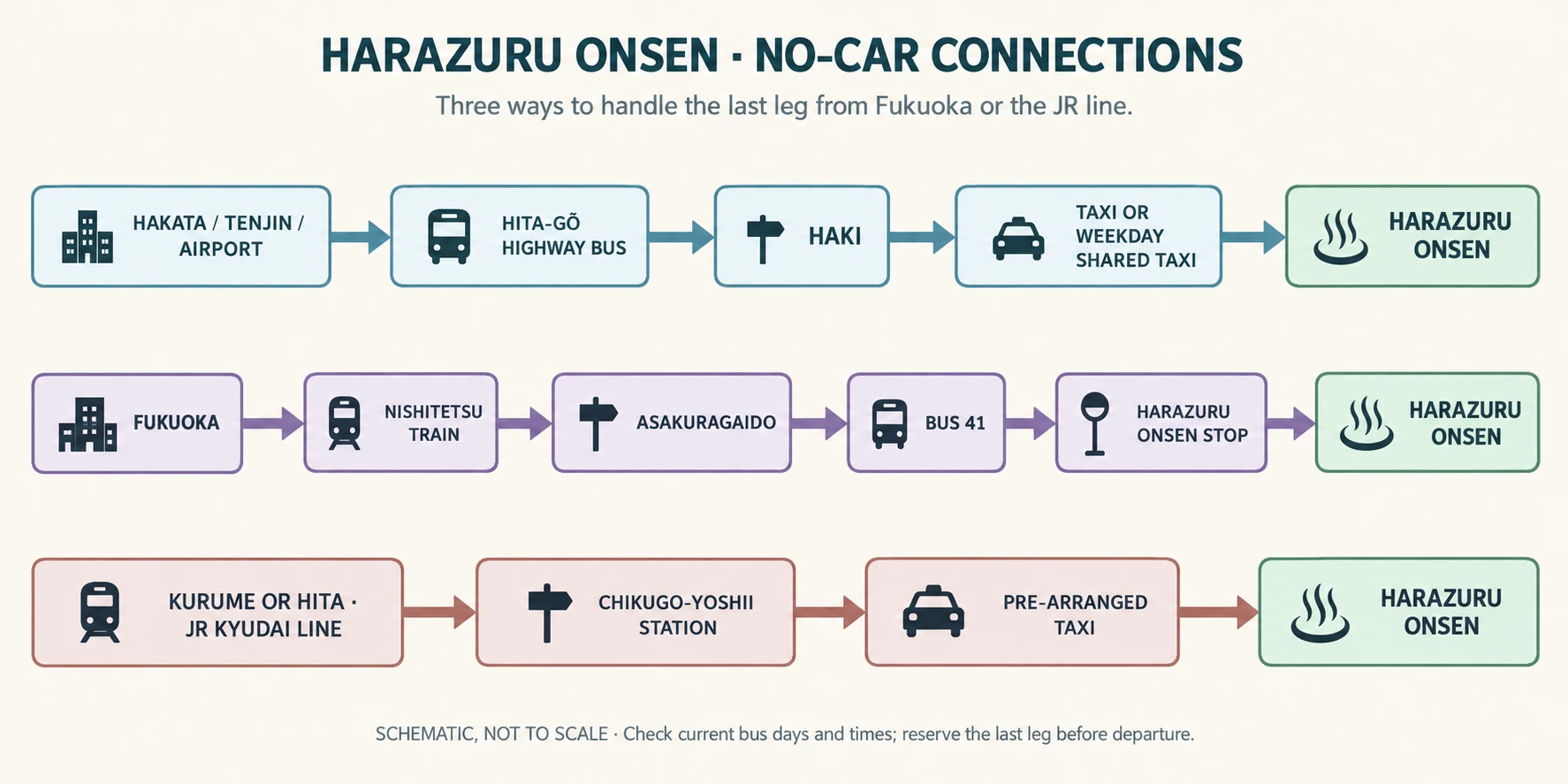
Choose the return ride before you choose a bath. Hita-gō does not reserve seats, bus 41 runs only a handful of times each day, and the Haki shared taxi is a weekday service that requires registration and a booking. The diagram maps the three options; it is schematic, not to scale.
For bath opening hours and last admission, use our Harazuru day-use bath comparison. If your route continues toward Hita, compare Hita without a car, Hita day-use baths, Hita family baths, Hita riverside bathing, Amagase day-use baths and Amagase without a car.
Hita-gō to Haki: fewer transfers, but a separate ride remains
Hita-gō runs from Hakata and Tenjin toward Hita, with some services also serving Fukuoka Airport’s domestic terminal. Haki is the closest highway-bus stop for Harazuru Onsen, but it is not in the bath district. Check the airport row carefully: only some departures serve the domestic terminal. The Hita Bus schedule was revised on October 1, 2026; the operator currently describes the route as unreserved and warns that a full coach may leave passengers waiting for another service.
From Haki, a taxi is the most flexible onward connection. Taisenkaku’s published shuttle is for overnight guests, not day-use visitors. Its access information requires a reservation by 6 p.m. the day before and specifies a pickup window; if you are visiting only to bathe, arrange a taxi yourself rather than assuming the inn will collect you. Enmeikan and Ryokan Toyotomi also list transport information, but their current pages do not clearly promise pickup to walk-in bathers.
Asakura City’s shared Haki taxi costs ¥300 each way per passenger (about HK$15 / NT$62). It is a lower-cost option for a weekday arrival, not a walk-up taxi.
| Haki shared taxi | Rule |
|---|---|
| Operating window | Weekdays, 8 a.m.–5 p.m. |
| No service | Weekends, public holidays, and December 31–January 3 |
| Booking | Register first; reservations open one week ahead and close one hour before departure |
| Capacity | Limited; reserve before relying on it |
The highway coach is the most direct choice from Hakata or Tenjin when your timing lines up. Keep enough time in Haki to meet the shared taxi, then confirm the return slot before starting your bath. The Hita-gō timetable changed on October 1 and the operator ended its return/pair ticket; older fare and ticket references may no longer apply.
Nishitetsu rail plus bus 41: the route that enters the onsen area
If you want to avoid arranging a private ride from Haki, travel on the Nishitetsu line to Asakuragaido and change to route 41. The bus runs between Asakuragaido and Haki via Harazuru Onsen. Asakura City lists approximately 9.5 round trips on weekdays and 10 on weekends and public holidays. That is enough to make a day trip possible, but not enough to treat the service like an urban bus.
Choose the bus out and back before leaving Fukuoka. A missed departure can consume a large part of a short visit. Bus 41 stops in the onsen district rather than at every hotel entrance; check the distance from your chosen inn, especially if you have luggage or want to avoid a roadside walk. Enmeikan is listed as a short walk from the Harazuru Onsen stop, while other properties may need a taxi or a longer walk.
This option is strongest for weekends because Asakura City’s Haki shared taxi does not operate then. It is still two public-transport stages from central Fukuoka, and the bus timetable—not a bath’s published closing time—sets how long you can stay. If you are extending the trip, compare Hita and Amagase or the Hita family-bath options.
JR to Chikugo-Yoshii: practical if you are already on the line
Chikugo-Yoshii Station is on the JR Kyudai Main Line between Kurume and Hita. The final drive to the Harazuru inns is about ten minutes, so arrange a taxi both ways before boarding the train. A rail trip from central Fukuoka is not automatically simpler than Hita-gō: you still need a transfer and a separate vehicle after the station.
Do not count on a ryokan shuttle unless the property confirms that day-use guests may use it. Taisenkaku explicitly limits its service to overnight guests. The other inns’ transport pages do not clearly guarantee pickup for a day-bath reservation. Agree on the return pickup point and time before entering the bath; local taxi availability is not assured in the operators’ published information.
JR Kyushu’s live station timetable is the right reference for the day you travel. The train gap changes by weekday, weekend and date, so an example from a past timetable is not a safe departure plan. If a bath visit ends near the final train you can catch, choose an earlier taxi and train rather than trying to fit in one more soak.
Which route should you book?
| Starting point | Route | Last leg | Best fit |
|---|---|---|---|
| Hakata, Tenjin or selected airport departures | Hita-gō to Haki | Taxi or registered weekday shared taxi | Few transfers from Fukuoka, provided the final ride is secured |
| Fukuoka by Nishitetsu line | Train to Asakuragaido, then bus 41 | Walk or local taxi from the Harazuru stop | Avoiding a separate car transfer, especially on a weekend |
| Already travelling on the JR Kyudai line | Train to Chikugo-Yoshii | Pre-arranged taxi | Travellers coming from the Kurume or Hita side |
Keep the town’s geography in mind. The highway-bus stop at Haki is several kilometres from the baths; the route 41 stop is in Harazuru; and Chikugo-Yoshii is a separate station connection. They are not interchangeable pins on one short walk.
Make the bath reservation fit the transport
A day-use visit can be refused or shortened when an inn is busy, and private bathing rules vary by property. Confirm opening hours and final reception with the bath before buying transport. For a night on the route, compare Hita riverside inns and baths or Hita’s Mameda area, then check the return connection before reserving.
If the return timetable leaves too little margin, staying overnight removes the pressure of catching the last bus, but it does not make every shuttle available to day visitors. For a wider no-car planning context, read Hita by public transport, Hita day-use baths, Hita family baths and Amagase without a car. The nearby Hita and Amagase comparison shows how the two areas differ as public-transport stops.