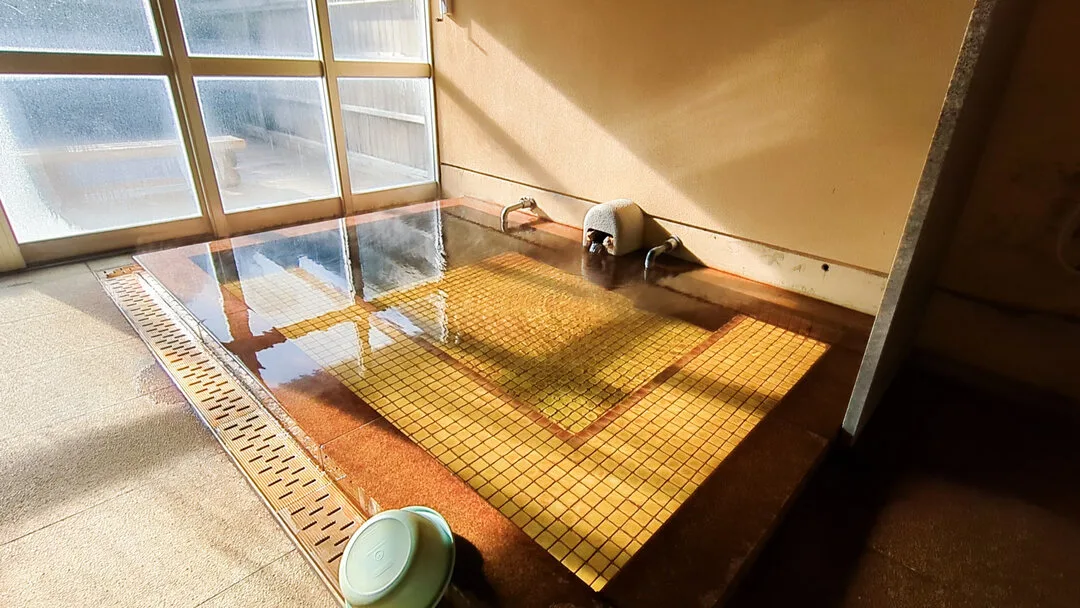
Konohana no Yu vs Gokurakuyu Miyazaki: Which Low-Temperature Onsen Fits Your Trip?
Konohana keeps a 32.7°C source bath; Gokurakuyu has a sauna and late city hours.
These two springs suit different moments in a Miyazaki itinerary. Konohana’s cool, unheated pool makes most sense if you are already visiting Kaeda or Aoshima. Gokurakuyu is closer to the central station area and stays open late, making it easier to fit after dinner or a train arrival.
| Konohana no Yu | Gokurakuyu Miyazaki | |
|---|---|---|
| What the spring water does | A separate bath uses the 32.7°C source as it comes from the spring; the larger bath is heated and source-fed | The indoor “Shizen no Yu” is the natural-spring bath; the source is 25.5°C and the water is heated and treated |
| Spring type | Sodium-chloride and bicarbonate spring; weakly alkaline | Strong sodium-chloride spring; weakly alkaline |
| Adult admission | ¥500 | ¥800 |
| Bathing hours | 10 a.m.–9 p.m.; last entry 8:30 p.m. | Weekdays 9 a.m.–1 a.m.; weekends and public holidays 7 a.m.–1 a.m.; last entry 12:20 a.m. |
| Best fit | A drive around Aoshima or Kaeda, or a visit specifically for the source bath | A late city soak, sauna and cold bath, or a stop near Miyazaki Station |
One source stays cool; the other is brought to bathing temperature
Konohana has two pools using the same spring in different ways: the named source bath receives the water at 32.7°C without heating, while the main bath warms it first. A 2019 analysis measured the spring at 32.5°C, pH 8.22 and 221.6 litres per minute. That older lab sheet and the city’s present 32.7°C description are separate records, not a fresh 2026 analysis.
Gokurakuyu’s analysis gives the source temperature as 25.5°C, but the indoor Shizen no Yu is heated before bathing. The operator also documents dilution, circulation filtration and chlorine disinfection as part of its water management. The source is sodium chloride water with high salinity; the public bath page identifies the Shizen no Yu as the natural hot-spring pool.
The same analysis records a flow of 18 litres per minute. Gokurakuyu lists its other tubs separately, so the spring analysis should be applied to the named natural bath rather than the entire bathing area.
In practice, Konohana offers a cool pool that does not need a sauna to make the visit worthwhile. Gokurakuyu’s spring is one stop in a fuller circuit of heated pools, sauna and cold bath.
Choose by location, timing and what you want to do afterward
Konohana sits in Kaeda south of the city centre and provides parking for 200 cars. It pairs with Aoshima, the sports park or a Kaeda Valley walk. Without a car, the added transfer can quickly outweigh the ¥300 gap between adult tickets.
Its bathing day ends at 9 p.m.; the last entry is 8:30 p.m. Plan this stop earlier in the day.
Gokurakuyu runs until 1 a.m. daily, taking final admissions at 12:20 a.m. Weekend and holiday opening moves forward to 7 a.m.; weekdays start at 9. Shampoo and body wash are supplied, but towels are extra: a rental set is ¥420. Its posted rules prohibit tattoos. An October 2026 maintenance notice closed the baths October 27–29 and scheduled reopening for 9 a.m. October 30; check the operator’s latest notices for later changes.
Read the full Konohana no Yu guide and Gokurakuyu sauna guide for facility details. Other routes: Miyazaki City’s day-use baths, private baths around Aoshima, Honoka Kaeda, Kushima’s Ikoi no Sato, Kannon Sakura no Sato, Yupo-Po or Laspa and the Kyomachi baths guide.
Fit it to the day you already have
Choose the cooler source pool when Kaeda is already on your itinerary. Save Gokurakuyu for the late city soak or when sauna time matters more than bathing at spring temperature. Its water-treatment page gives the practical detail behind the word “natural.”
